
What we’re looking at
Iain Dawson is constantly looking out for creative inspiration, from all corners of the globe. What I’m reading, exhibitions I’m loving and more………
Billionaires, Identity, and the Culture They Control
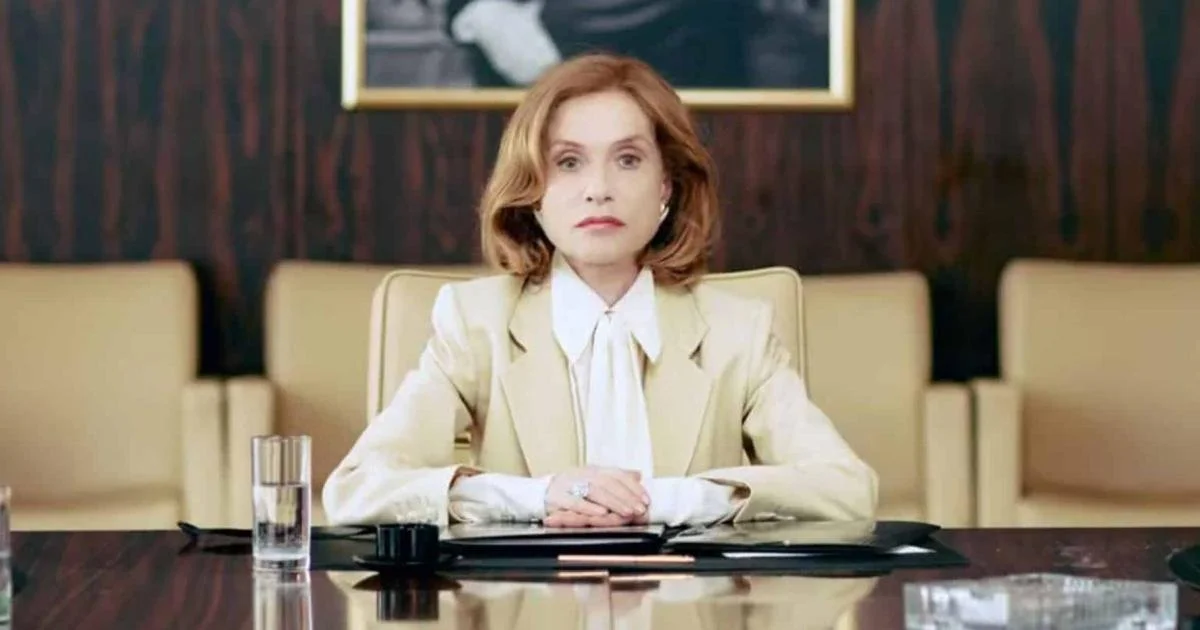
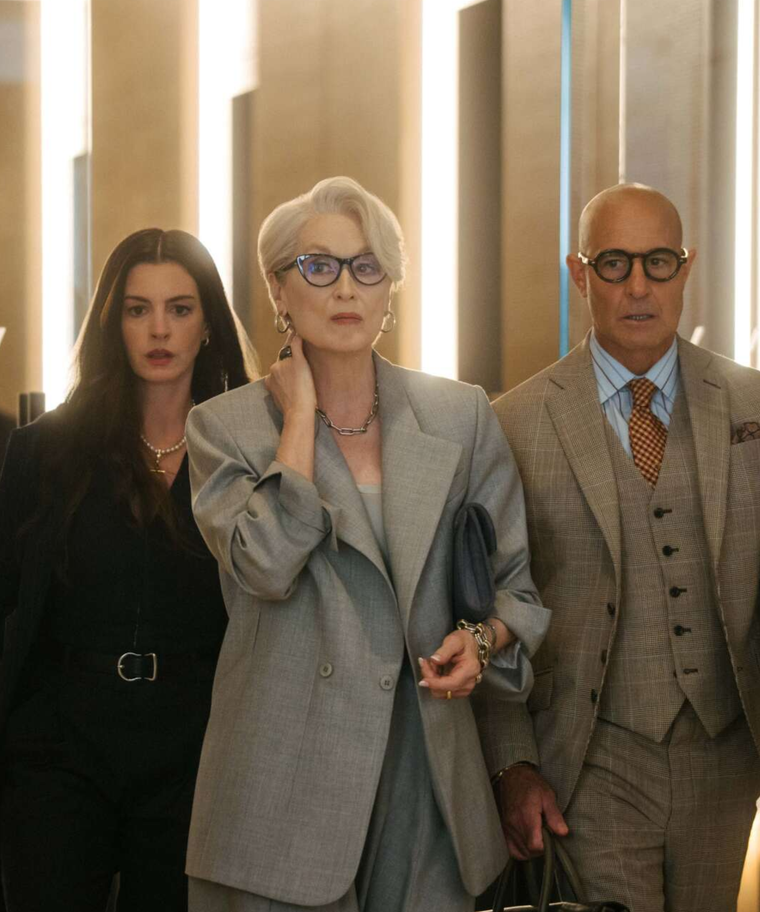
What does it mean to own culture? That question sat with me across two films I caught over the weekend — The Devil Wears Prada 2 on Friday evening at HOTA Cinema on the Gold Coast, and The Richest Woman in the World at Palace Cinema in Byron Bay on Saturday afternoon. Seen in sequence, they form an unexpectedly coherent double bill, and I found myself drawing connections that I want to think through here.
When Cultural Authority Meets Capital
The Devil Wears Prada 2 is, on its surface, a legacy sequel about fashion media. But as I watched it, I kept thinking about something closer to an elegy — for editorial instinct, for institutional authority, for the idea that a magazine could matter. Miranda Priestly is no longer the untouchable dragon she was in 2006. She is, as Time magazine observed in its coverage of the film, "an old-school pro with magazines in her blood," navigating a world where clicks have replaced curation. The film's sharpest insight is that billionaire ownership may now be the only lifeline for legacy print media — and that this is a bleak prospect, not a hopeful one. The Richest Woman in the World, directed by Thierry Klifa and premiering at Cannes in 2025, covers adjacent terrain from a different angle. Isabelle Huppert plays Marianne, an imperious heiress who lavishes her fortune on a younger gay artist, triggering a scandal and a legal battle over whether she is patron or victim. Variety described the film as having "all the ingredients for a vicious satire on wealth and corruption, but never biting hard enough" — a criticism that, interestingly, has also been levelled at the DWP sequel, which one reviewer called a "shiny soap-bubble satire of a doom-laden cultural landscape."
Identity Under Pressure: What Both Films Are Really About
The thread that connects these two films, for me, is identity — specifically, the identity of powerful women whose entire sense of self has been built around cultural authority. When that authority is challenged, what remains? This is territory that Iain Dawson explores consistently through the work at identity cultural projects, and it is striking to see mainstream cinema circling the same questions. Both films are restrained where they might be savage. Both are glamorous where they might be merciless. And yet both register something real about the current moment: that culture is increasingly owned by a diminishing number of very wealthy people, and that the artists, editors, and patrons who once defined the cultural landscape are finding the rules have changed beneath their feet. The Saturday Paper and The New Yorker have both, in recent years, run extended pieces on the crisis in media identity and the hollowing out of editorial culture — a conversation that these films, however gently, are joining. There is also something fitting about the venues. HOTA is a publicly funded arts institution; watching a film about the privatisation of cultural power inside a publicly funded cinema carries its own irony. Palace Byron Bay, with its carefully curated international program, feels like the right room for a French-language film about a billionaire's relationship to art. I think these films are worth your time — imperfect, yes, but honest about the landscape we are all navigating. ---
Iain Dawson is a writer and cultural commentator whose work examines identity, power, and the intersections of art and public life.
The River
Sydney Theatre Company
Drama Theatre | SOH
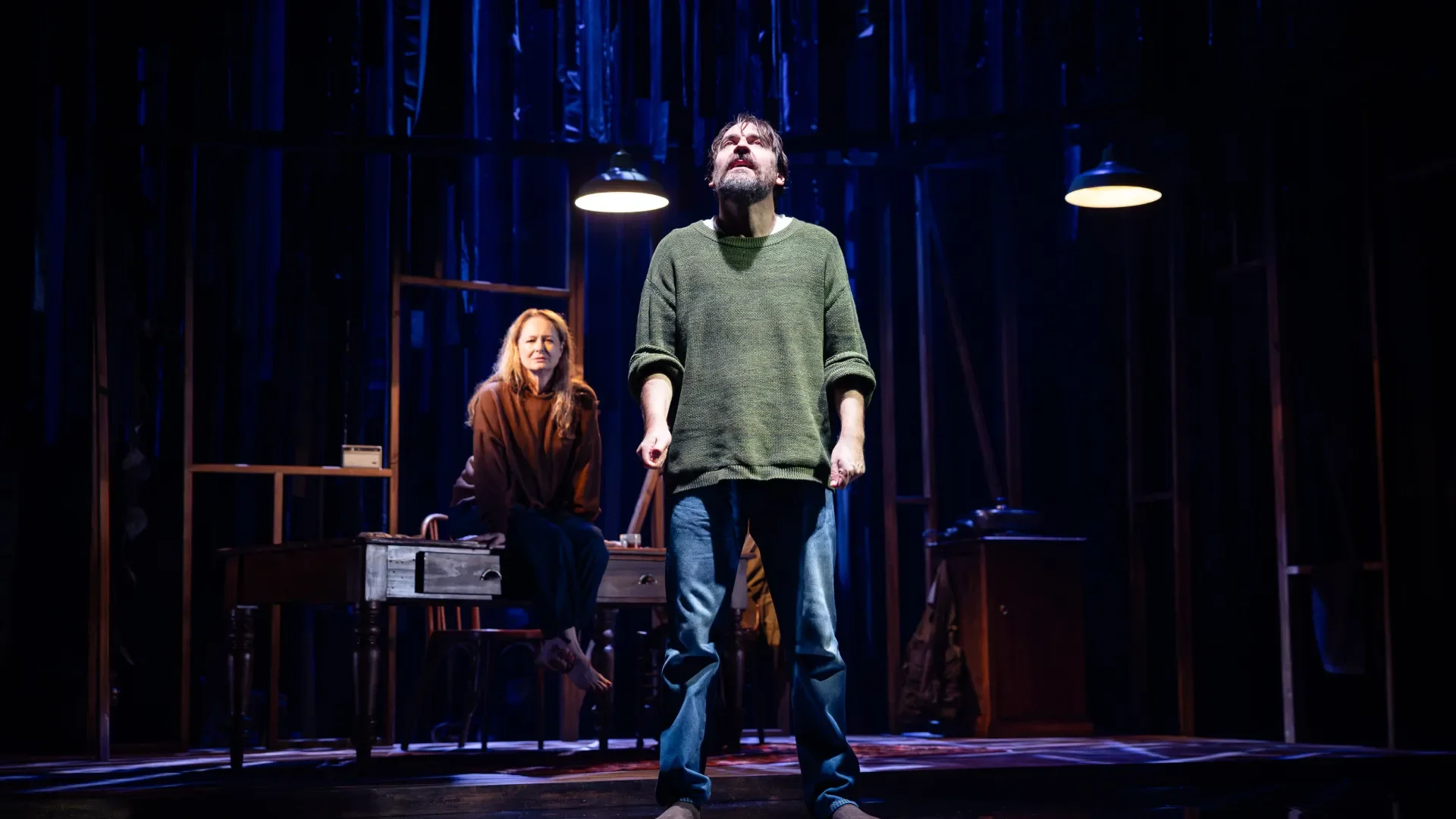
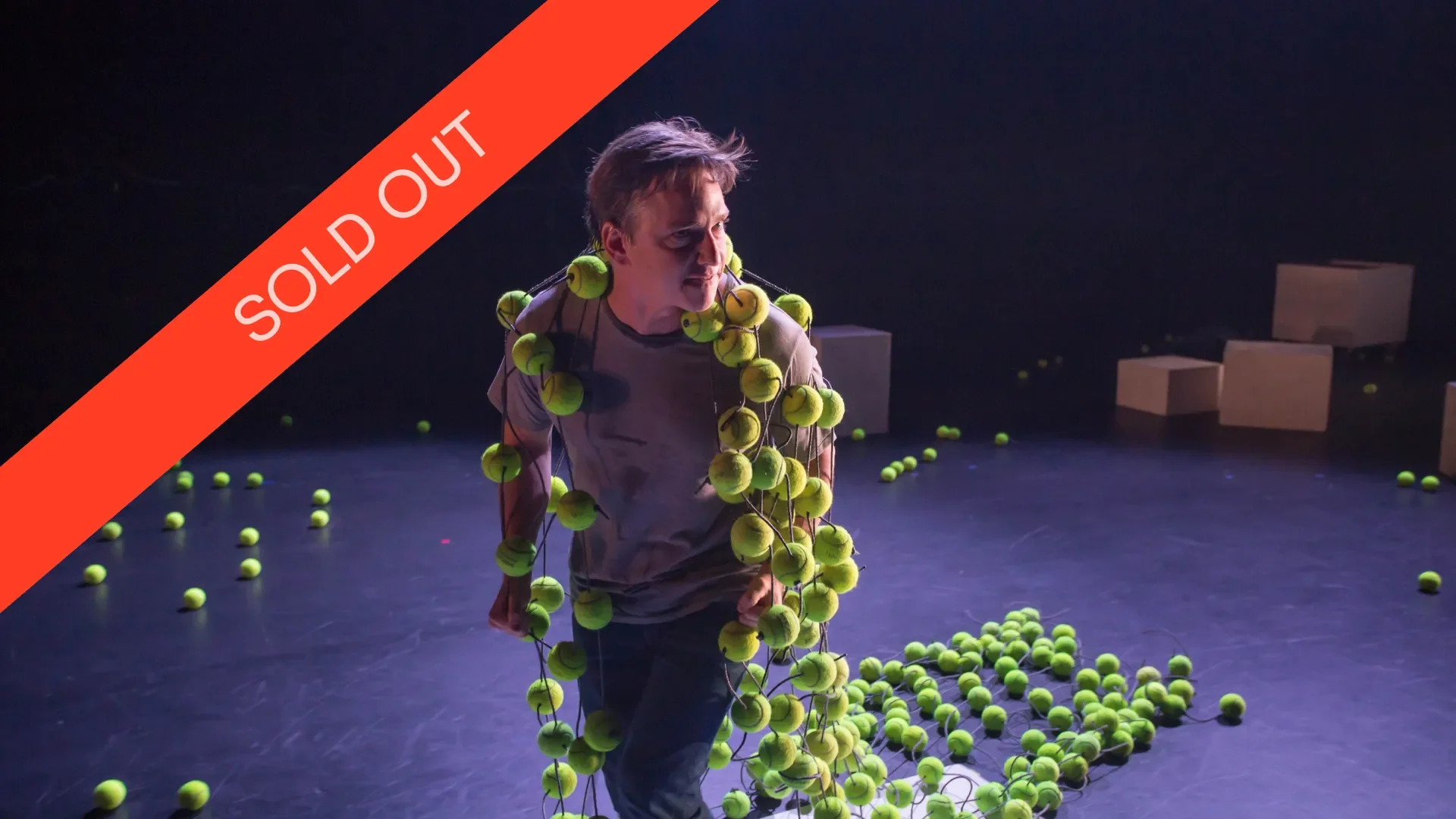
There are plays that leave you with answers, and then there are plays that leave you standing in the foyer, still turning the experience over in your mind long after the lights have come up. Jez Butterworth's The River, currently playing at Sydney Theatre Company, is firmly the latter. I caught the Saturday night performance on 9 May, and it stayed with me. A Long-Overdue Australian Encounter with Jez Butterworth For those unfamiliar, The River premiered in London in 2012 before transferring to Broadway in 2014. That it has taken over a decade to reach Australian audiences in a major production feels like something of a cultural gap — one that Sydney Theatre Company has now, thankfully, moved to fill. Jez Butterworth, best known locally for Jerusalem, is one of the most compelling voices writing for the stage today, and as Iain Dawson has long argued through the work of [Identity Cultural Projects] access to challenging international theatre matters enormously for the health of our cultural landscape. The River is a short, dense, elliptical piece — barely 80 minutes — set in a remote fishing cabin where a man brings a woman, though the question of which woman, and when, becomes increasingly unstable as the play progresses. Butterworth withholds as much as he reveals, and the architecture of the piece depends entirely on the commitment of its three performers.
The production is anchored by three exceptional performances, but it was Andrea Demetriades who proved the standout of the evening. Her presence on stage carries a rare emotional precision — she commands attention not through force but through absolute authenticity. In a play where ambiguity is the whole point, Demetriades gives her character a grounded interiority that makes the slipperiness of the text feel genuinely unsettling rather than merely clever. It is the kind of performance that reminds you why live theatre cannot be replicated. The image above captures something of that charged atmosphere — two figures in a dimly lit space, one standing with clenched fists and eyes cast upward, the other watching with quiet intensity from the shadows. It is a visual that perfectly encapsulates the tension Butterworth constructs: intimacy edged with something unresolved.
If the play has a weakness, it is that its deliberately opaque conclusion may frustrate audiences seeking resolution. I would argue this is actually a feature rather than a flaw — theatre that trusts its audience to sit with uncertainty is increasingly rare — but there is a fine line between productive ambiguity and a sense of incompletion. The River walks that line carefully, if not always steadily. What this production makes abundantly clear is that Australia needs more Jez Butterworth, and sooner than every decade or so. The work repays serious staging and serious audiences, and STC has delivered both. The River is a recommended night out for anyone who wants theatre that genuinely challenges.
Iain Dawson 9 May 2026
IMA Brisbane
Mandy Quadrio: Kukunna Wurraweena &
Erika Scott: Cambium Itch
18 April – 28 June 2026
The Institute of Modern Art's second quarter program pairs two Queensland-based artists in ways that, at first glance, seem entirely oppositional — one interior and grieving, the other exuberant and chaotic — yet both are deeply preoccupied with what surfaces hold and what they conceal.
Mandy Quadrio: Kukunna Wurraweena
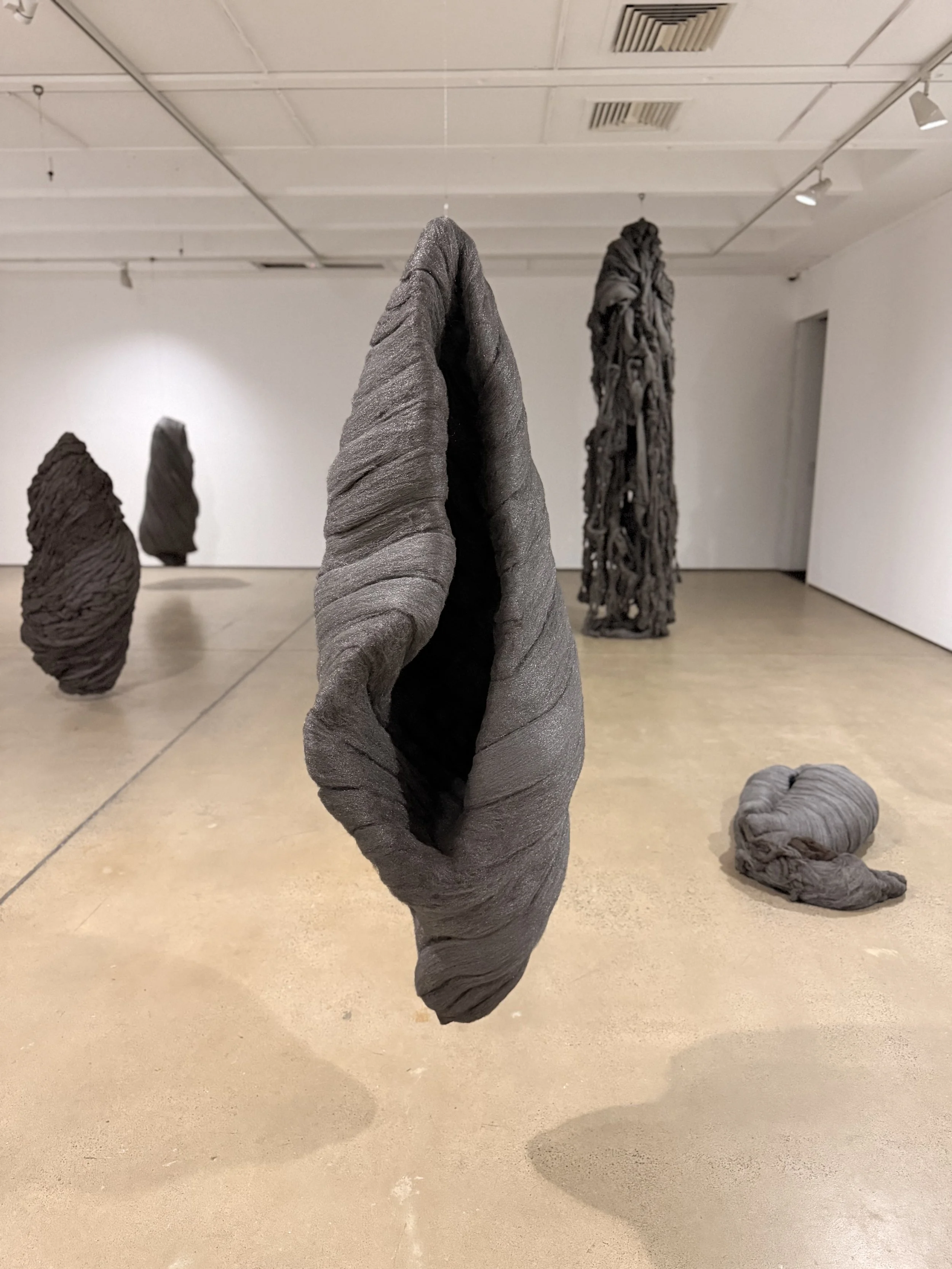
Walking into Quadrio's exhibition is to enter a kind of hush. Her show features an austere forest of suspended steel-wool sculptures — an abrasive material that has been gently worked by the artist, transforming it from a coarse tool into soft, yielding bodies and comforting shelters. The effect in person, captured in your photographs, is remarkable: the dark grey forms hover at varying heights and scales, some enormous and upright, others coiled low on the floor like sleeping creatures. The polished concrete amplifies their presence, their shadows pooling beneath them.
The vulval and womb-like forms suggest generations of maternal comfort — a copse within which we might safely commune with the past, despite the colonialist attempts to scrub her and her people away. The steel wool — a cleaning tool, an erasure instrument — is transformed into something tender. That inversion is the conceptual engine of the work, and it is quietly devastating. The exhibition title loosely translates as 'holding the weight of silence.'
Your image of the suspended form hanging mid-air, split open like a seed pod or a wound, captures the work's dual nature perfectly. These are simultaneously sheltering and exposed, protective and vulnerable. The larger walking-scale forms suggest ancient standing figures, and the walk-through piece photographed from the back — low to the ground, cavernous — invites a bodily reckoning the photographs can only hint at.
In Tugrannah: A Black Pause at the Beginning, Quadrio's first moving-image work, we are presented with incandescent filaments igniting in brilliant flashes and streams, their intricate paths intersecting like neurons firing in the brain or stars streaming through the cosmos. Your photograph of the video projection — that blazing line of orange-white light against a grey-blue ground — is electric. The soundtrack features the artist and her sister — who has since passed — singing and speaking to each other; Quadrio enters a dialogue with her sister, reaching into the past, bringing it into the present, inviting us to gather, sit, and stare into the fire. The work is at once geological, cosmological, and deeply personal — fire as memory, as grief, as continuation.
Quadrio is a Trawlwoolway/Tasmanian Aboriginal woman, also of European heritage, connected to her ancestral Country of Tebrakunna, north-east Lutruwita/Tasmania. Her practice navigates the tension between erasure and persistence, and Kukunna Wurraweena is among the most quietly powerful things currently showing in Brisbane.
Worth noting: Quadrio's work is also currently appearing in the Sydney Biennale — a full critique of that presentation to come — making this an important moment to track her practice across two very different institutional contexts.
Erika Scott:
Cambium Itch
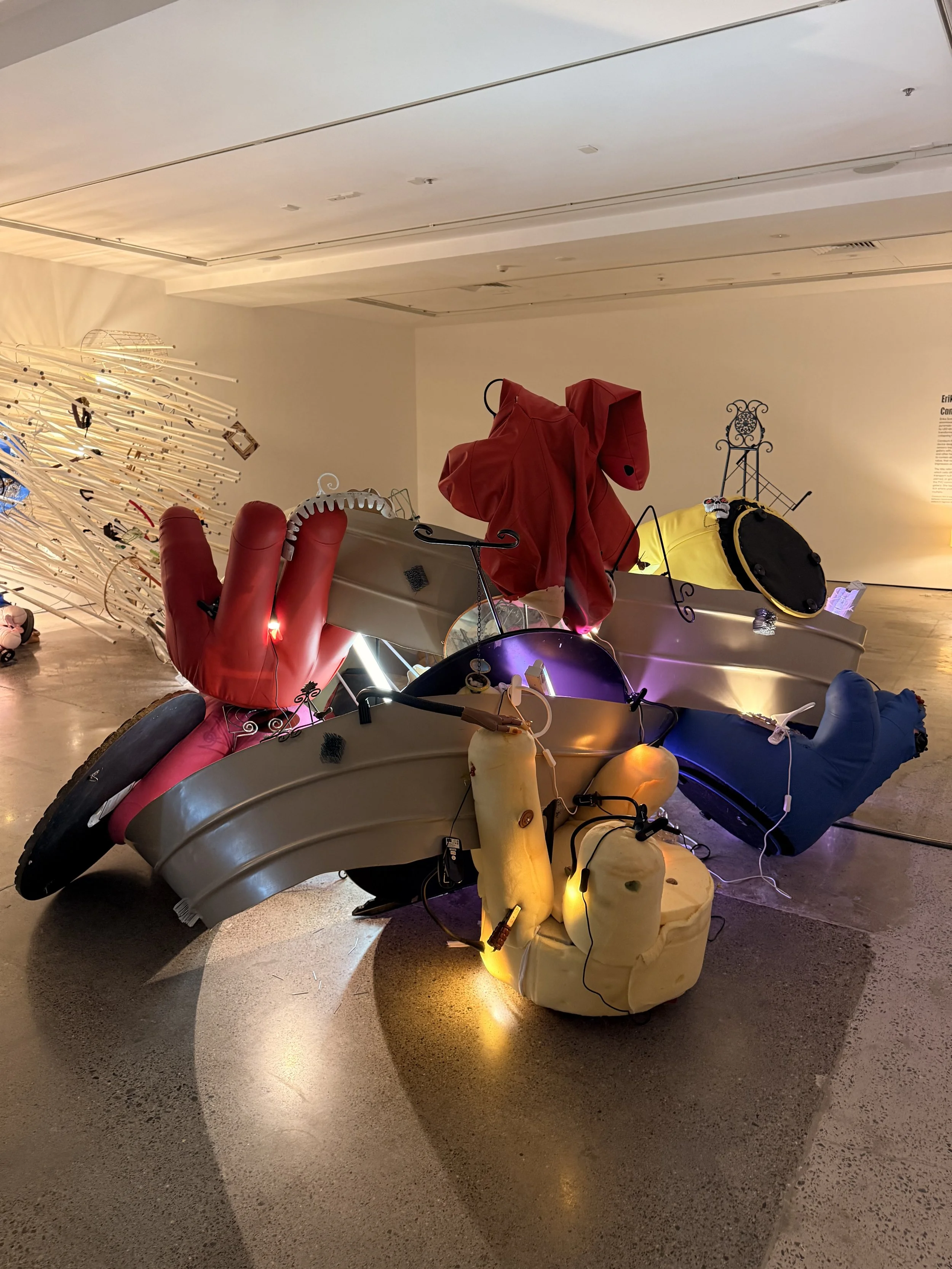
If Quadrio's work asks you to be still, Scott's refuses to let you. Scott is known for her maximalist sculptures of detritus: enormous hourglasses floating in inflatable pools and draped in cables; pyramids of aquariums bubbling with stagnant water illuminated by LED strips. She extracts the junk from consumer culture and transforms it into a sensual explosion, exciting its haptic qualities, and collapsing boundaries between object, image, and viewer.
Cambium Itch takes the form of a supersized 'pin-art toy' — the sensory device designed by artist Ward Fleming in 1976 — scaling up the sensory experience and filling the gallery with junk: PVC pipes, plastic tubing, chair upholstery, lamps, and other hard-rubbish jetsam. Your photographs capture the sheer deranged generosity of the installation: inflatable red and yellow stuffed-toy limbs tumbling into and out of a large aluminium boat-like vessel; a disc of dense LED circles functioning as a kind of flattened spotlight or eye; curtains of white PVC rods radiating outward like a porcupine or a collapsed sun; a black leather bean bag slumping nearby like an exhausted observer. The ornate iron stands that pepper the installation — holding mirrors or sun-burst forms — bring an incongruous decorative flourish, as if a flea market has been caught mid-explosion.
The title refers to the cambium layer in plants, the tissue from which cells differentiate, and Scott uses this metaphor to describe her puncturing of the IMA's walls — the PVC piping penetrating the gallery structure, tapping into some subdermal creative layer where undifferentiated thought might emerge and multiply. It's a generative, if somewhat breathless, idea. Where the work excels is in its sheer sensory insistence — you cannot be passive in front of it. Where it risks losing the viewer is in its refusal to resolve: everything is equally weighted, equally loud. But perhaps that is the point. Scott, based on Lamb Island in Redland City, has shown in the 2026 Adelaide Biennial of Australian Art: Yield Strength, and Cambium Itch feels like the work of an artist still usefully pushing at the edges of her own maximalism.
Together
The IMA has made an interesting curatorial bet pairing these two. The contrast between Quadrio's disciplined, muted palette and Scott's chromatically overwhelming excess is stark, but both are working at the boundary of the body — one through material that touches and shelters, the other through material that overwhelms and imprints. Both ask what gets left behind, what ghost remains in the object. Quadrio frames this in terms of cultural memory and survival; Scott in terms of consumer waste and sensation.
Both exhibitions run until 28 June 2026 at the IMA, Ground Floor, Judith Wright Arts Centre, Fortitude Valley. Free entry.
Dale Frank
Chicken Soup
There is a long-running gag inside Dale Frank's painting practice, and the title of his latest outing at Roslyn Oxley9 keeps it bubbling. Chicken Soup — folk remedy, Jewish-grandmother cure-all, byword for sentimental literature — is a strange thing to call a room full of poured chemical paintings on metallic ground. And yet, walking into the gallery's Paddington rooms, you are confronted with something that is both medicinal and slightly suspect: glossy panels that look as though they have been laced with something to make you feel better, or possibly hallucinate.
Frank has been pouring pigmented varnish onto aluminium and Perspex for the better part of two decades, and on first encounter Chicken Soup reads as an unapologetic continuation of that project. The works are large, square, mostly the artist's familiar two-by-two-metre format, hung at human scale on the gallery's white walls and timber floors so that they behave less like pictures and more like punctures — windows into a thinner, more volatile atmosphere than the one we are standing in.
The exhibition's hinge work, visible from the entrance, is a gold-grounded painting in which a slab of fluorescent watermelon-red lava has slid down the right-hand side of the panel, leaving behind a black tarry sediment and a few pale, almost mineral blooms in pink and bone. It is hung alone, on its own wall, and rewards that isolation. The mirrored gold ground does what Frank's surfaces always do — it implicates you, throwing back your silhouette and a smear of the room — but the painting also resists the easy seduction of that trick. The red is too saturated, too poster-paint-fresh; the black underneath is genuinely ugly, with a curdled, oxidised look. Standing in front of it, you can feel the artist's interest in the failure point of a pretty thing.
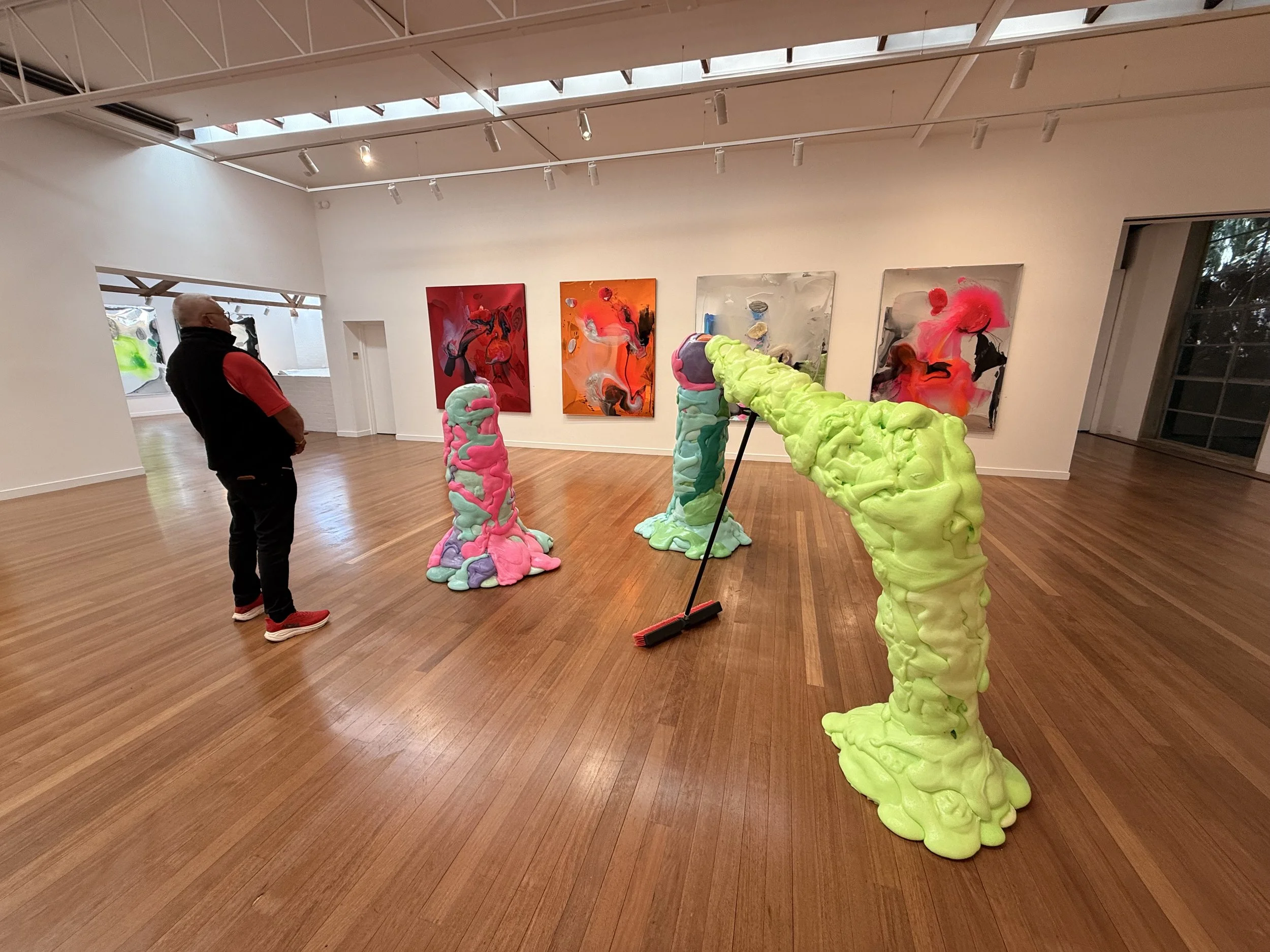
Move deeper into the second room and Frank's vocabulary opens out across four panels arranged like a chord. To the left, a work in which acidic chartreuse fronds claw through a wash of dusty pink; opposite it, a vertical slab dominated by an Aperol-orange pour that seems to be eating a hot magenta field. At the end wall, a smaller, square painting hangs as the room's keystone: a viscous tangle of fuchsia, tangerine, jade and inky black, the colours dragged together in a way that suggests both a CT scan and a melted Bunnings sign. Hung as a quartet, these works do exactly what Frank's installations have always tried to do — they push the viewer toward the realisation that what looks like emotional weather (a tantrum here, a sigh there) is in fact a set of carefully managed chemistries.
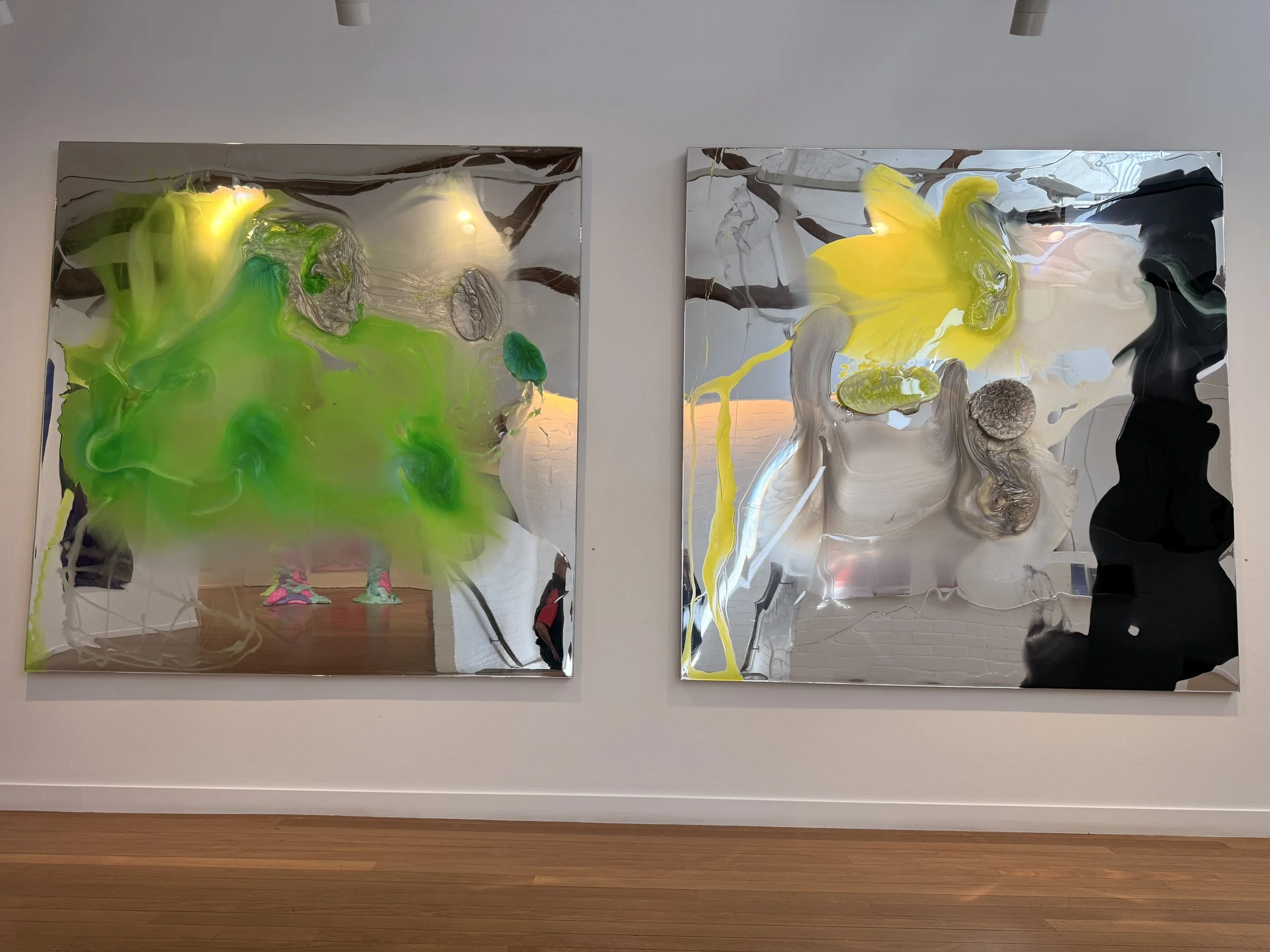
The most uncompromising room, though, contains a pair of mirror-finish panels that read almost as a diptych even if they are not formally one. On the left, a great pour of fluorescent green crashes from the upper corner toward the centre, dissolving into pale washes of mint and milk before evaporating into the chromed ground. On the right, its near-twin runs in yellow and dirty bone, with a black smear creeping in from the right edge like a shadow that has been left in too long. These two paintings push Frank's signature reflective ground further than anything else in the show. The mirror is so clean that the viewer becomes the work's underdrawing: you see your shoes, the gallery's beams, another visitor's red T-shirt, all caught in the painting before the painting decides to release you back. There is real cleverness in how this contradicts the title; Chicken Soup implies bodily warmth, but the surfaces here are cold, industrial and faintly clinical, the chrome of a hospital trolley rather than the steam of a kitchen.
If there is a criticism to be made of the show, it is the one that has trailed Frank for years: the technique is so reliable that occasionally a panel can feel less like a painting and more like a well-executed Frank. Three or four of the works in the middle gallery walk close to that line, where the colour decisions are more pleasing than they are necessary. But Frank seems alert to the danger himself. The most successful pieces in Chicken Soup are the ones that include something distinctly unwell — the bruised black bleeding out of the gold panel, the sour yellow eating into the mirror — as if the artist is dosing his own sweetness with something bitter.
That, in the end, is what Chicken Soup delivers. It is comfort food, but Frank has put something in it. The exhibition is recognisably his, occasionally too recognisably so, but the best works trade on a sly knowledge that gloss and care are not the same thing, and that what looks restorative can also be slightly toxic. After three decades of pouring, Frank is still finding ways to make a beautiful surface feel like it is asking you a question rather than answering one.
Dale Frank: Chicken Soup is on view at Roslyn Oxley9 Gallery, Paddington.
A strong edition
Sydney Biennale 2026
This weekend I visited the 25th Biennale of Sydney across White Bay Power Station, the Art Gallery of NSW, and the Chau Chak Wing Museum — and one work stopped me completely.
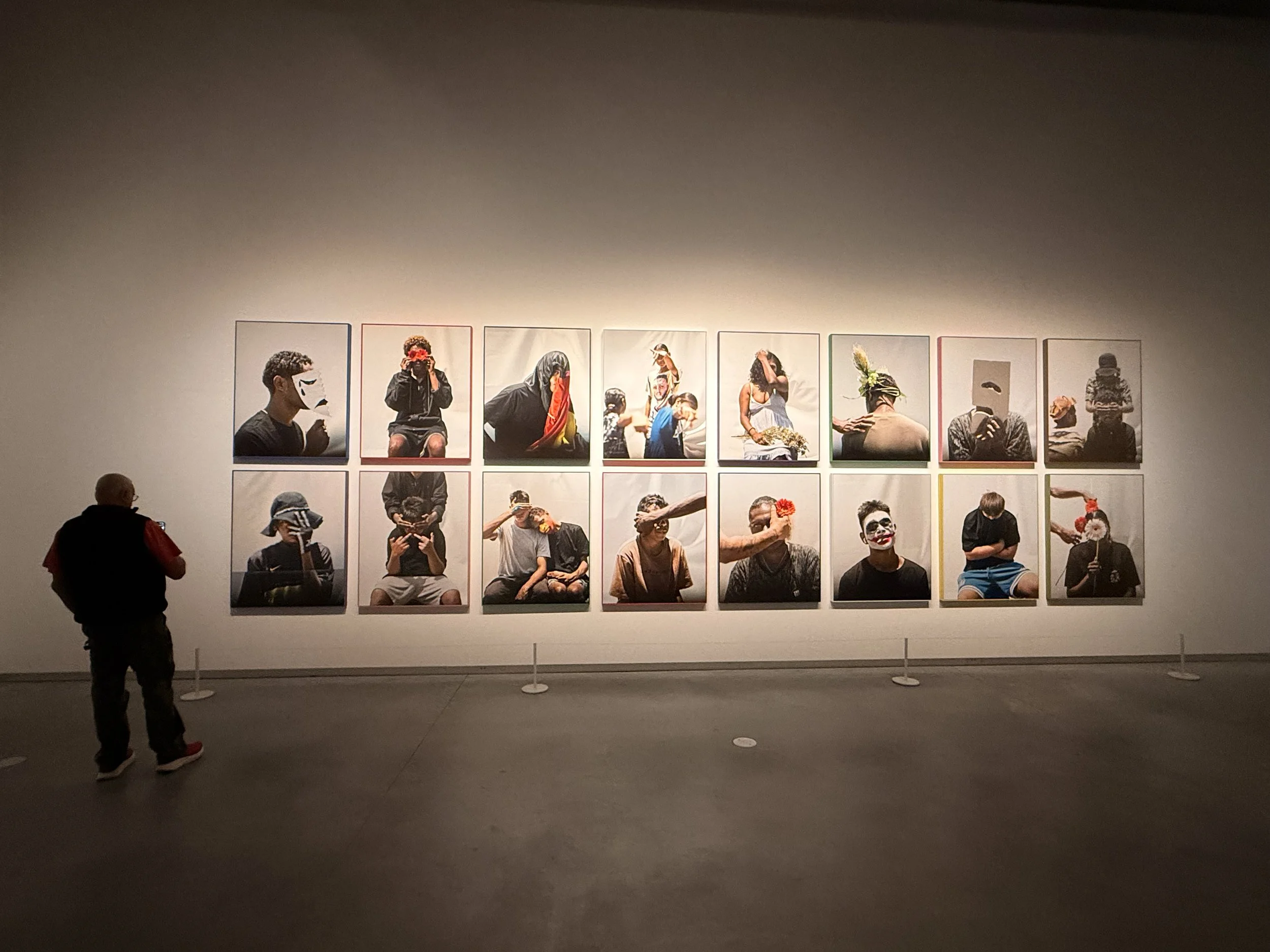
Code Black/Riot (Portraits) (2025) by Hoda Afshar and Vernon Ah Kee is fourteen large-format portraits of young people affected by Queensland's youth detention system, each framed in a different colour — red, yellow, green, blue — and each showing a subject who has chosen, in their own way, not to show their face.
A stormtrooper mask. A camera turned back at the lens. A t-shirt pulled upward. Native flowers woven into hair, back turned. And one image I can't stop thinking about: a young man staring directly into the camera with his face painted as the Joker — white, blackened eyes, red slashed grin, cigarette in his teeth. Completely composed. Completely in control of the image being made of him.
"Code Black" is the classification given to young people in detention deemed a crisis or emergency — a colour code instead of a name. The portraits push back against exactly that logic. These aren't case studies or documentary evidence. They are portraits, in the full art-historical sense: assertions of individuality, dignity, and inner life.
The collaboration between Afshar — born in Iran, who came to Australia as a refugee — and Ah Kee, a Kuku Yalandji, Waanji, Yidinji and Gugu Yimithirr artist who has long worked at the intersection of identity and state violence, feels like the right work made by the right people at the right moment. Their convergence of experience — of being processed, classified, managed by systems that were never built for you — gives the work an authority that goes well beyond advocacy.
Beautiful, furious, and completely unforgettable. My standout of the Biennale.
The 25th Biennale of Sydney runs until 9 June 2026. Go.
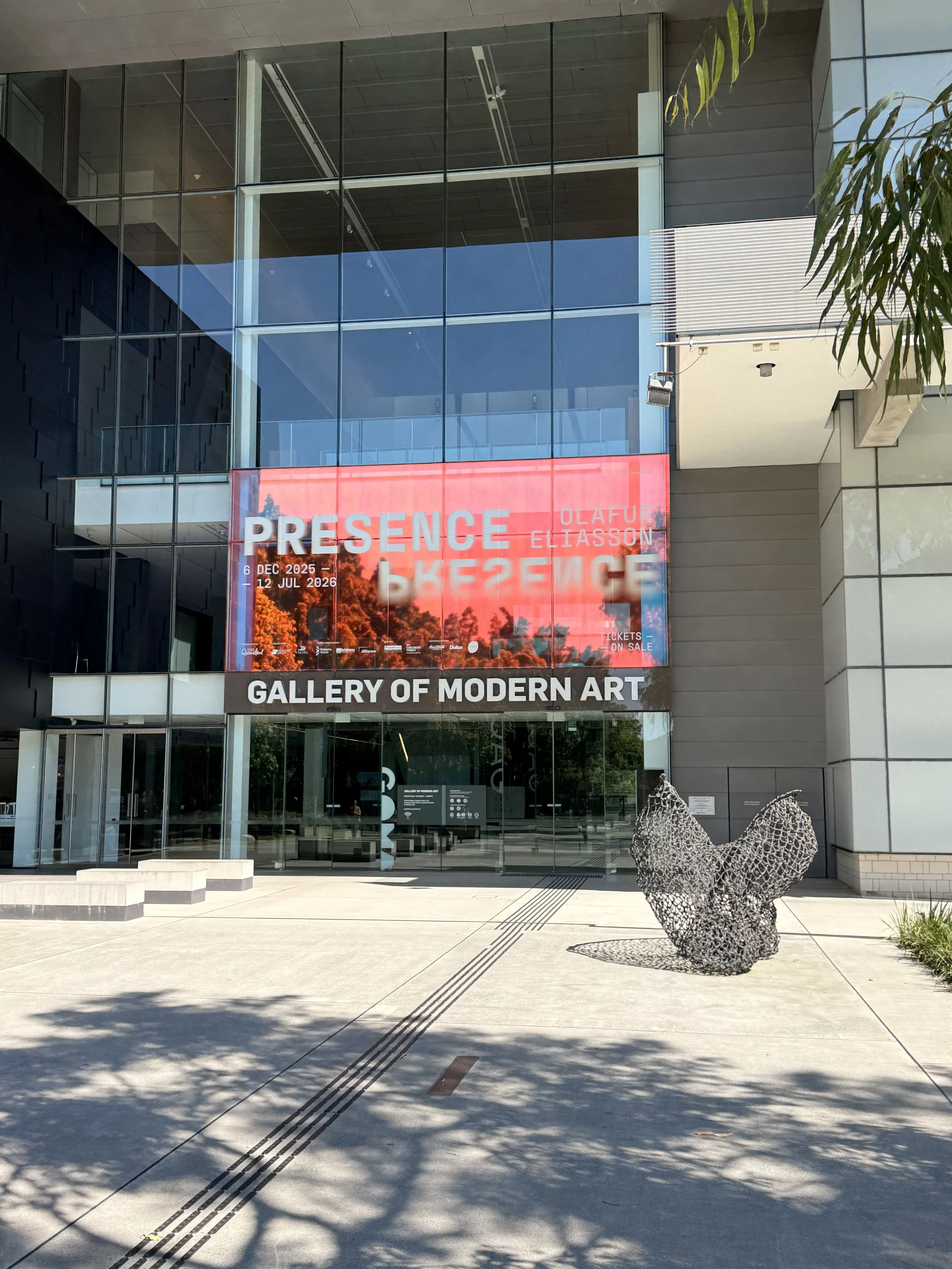
Olafur Eliasson’s Presence: An Exhibition That Makes You Feel First, Think Later
Olafur Eliasson: Presence
GOMA, Brisbane
6 December 2025 – 12 July 2026
Walking into Olafur Eliasson’s Presence feels less like entering an exhibition and more like stepping into a set of alternate atmospheres. Nothing is static; everything shifts around you. Light bends, stones grind underfoot, colours flicker in peripheral vision. Eliasson isn’t content to be looked at — he insists you feel your way through his work, body first, mind second. It’s a rare experience in a museum: to be genuinely disoriented, and in the best possible way.
The exhibition opens with a choice: which path will you take? Eliasson’s installations often operate on simple binaries — light/dark, wet/dry, warm/cold — but here the choice is symbolic. You choose, and in choosing, you become responsible for your own encounter.
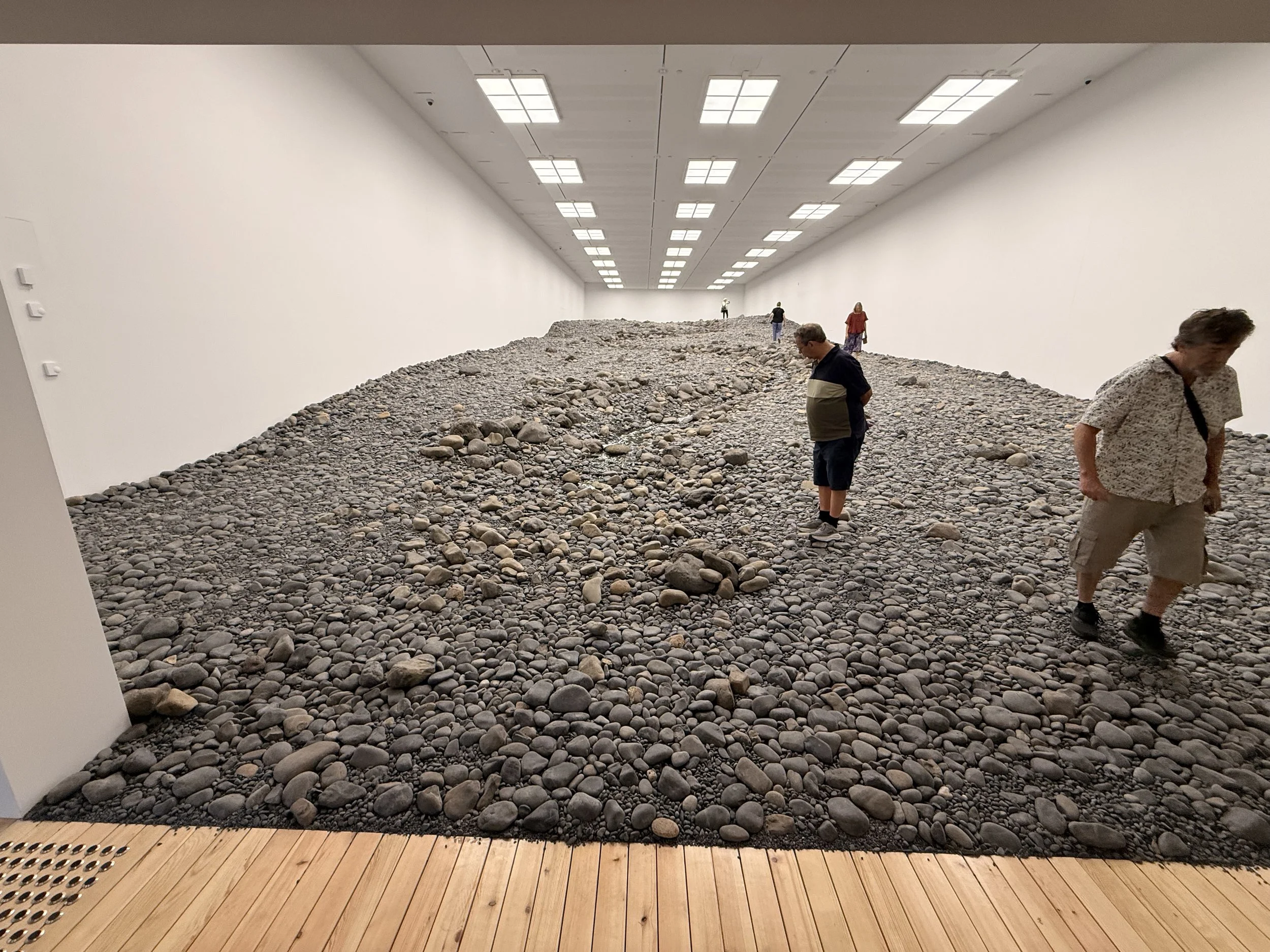
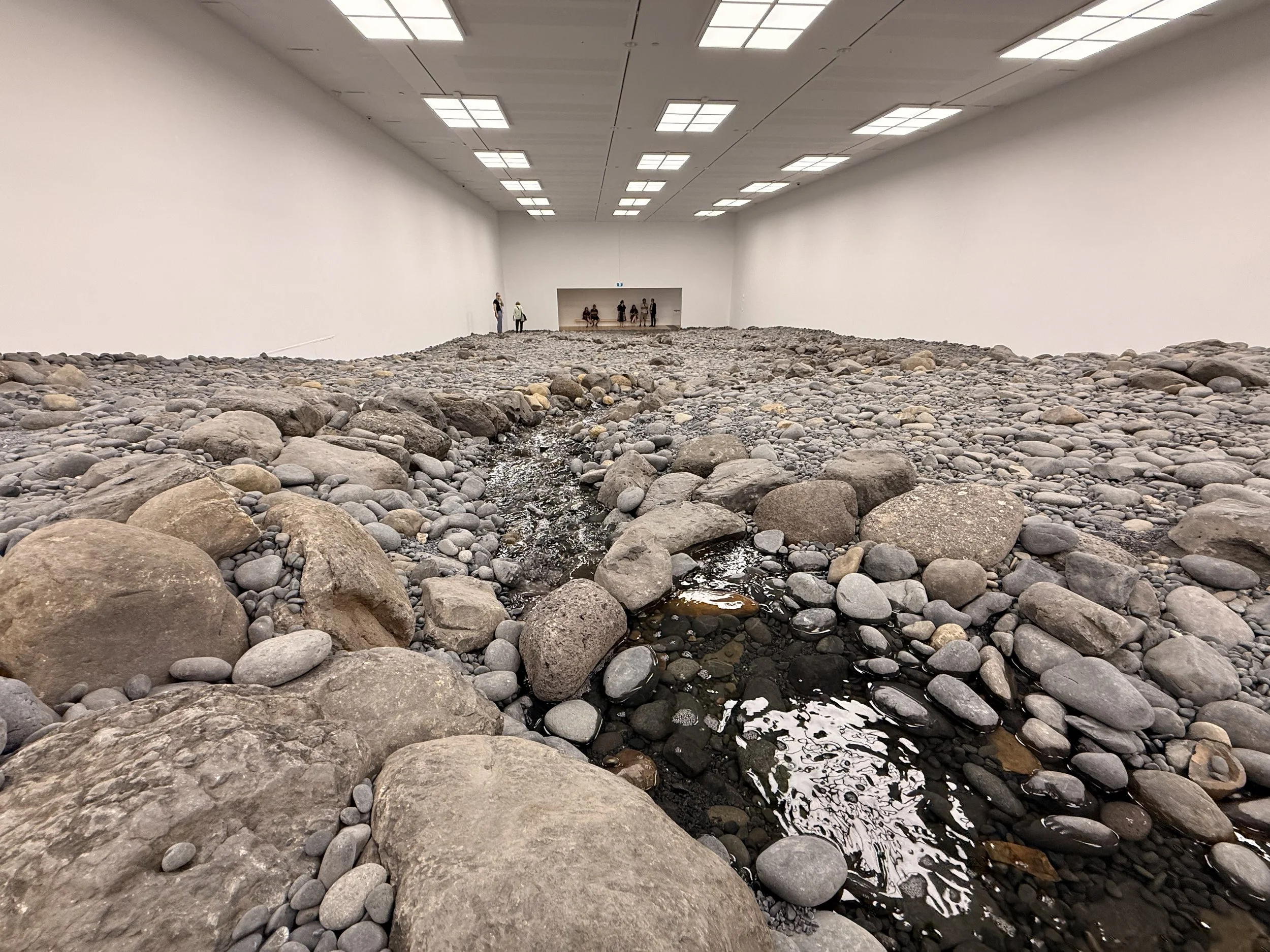
The first major work I stepped into was Riverbed (2014), re-installed in all its gravelly, geological glory. Nothing prepares you for the scale. A vast grey landscape of Icelandic stones rises and dips inside GOMA’s pristine white gallery, as if the building has cracked open to reveal a glacial riverbank beneath. Visitors pick their way across the stones, shoulders hunched, arms out slightly for balance — suddenly the gallery becomes a place of navigation rather than observation. Walking it, you become hyper-aware of your own weight, your own pace. It’s an artwork that activates the soles of your feet as much as your eyes. Wear sturdy shoes; this is not a politely carpeted experience.
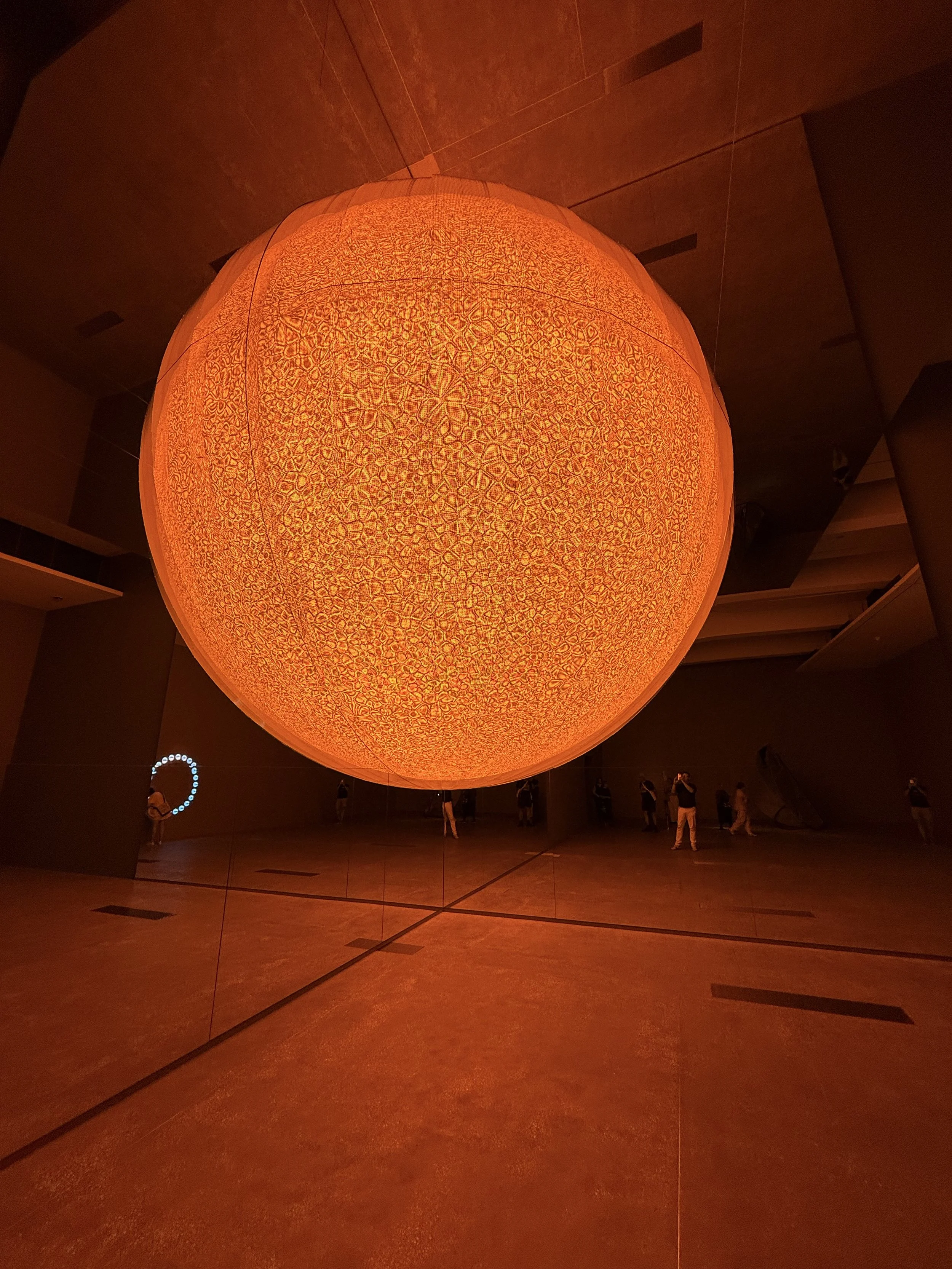
Further on, the atmosphere shifts dramatically. A giant glowing sphere hangs suspended in a mirrored chamber, radiating warm, honeyed light. Up close, it reveals a delicate lattice of patterns — geometric, almost cellular — that seem to pulse as you move around it. Reflected infinitely on every side, the sun-like orb becomes a cosmic hallucination, a meditation on perception and scale. You lose track of where the object ends and the reflections begin. The room hums with a soft sense of awe; people circle slowly, whispering without knowing why.
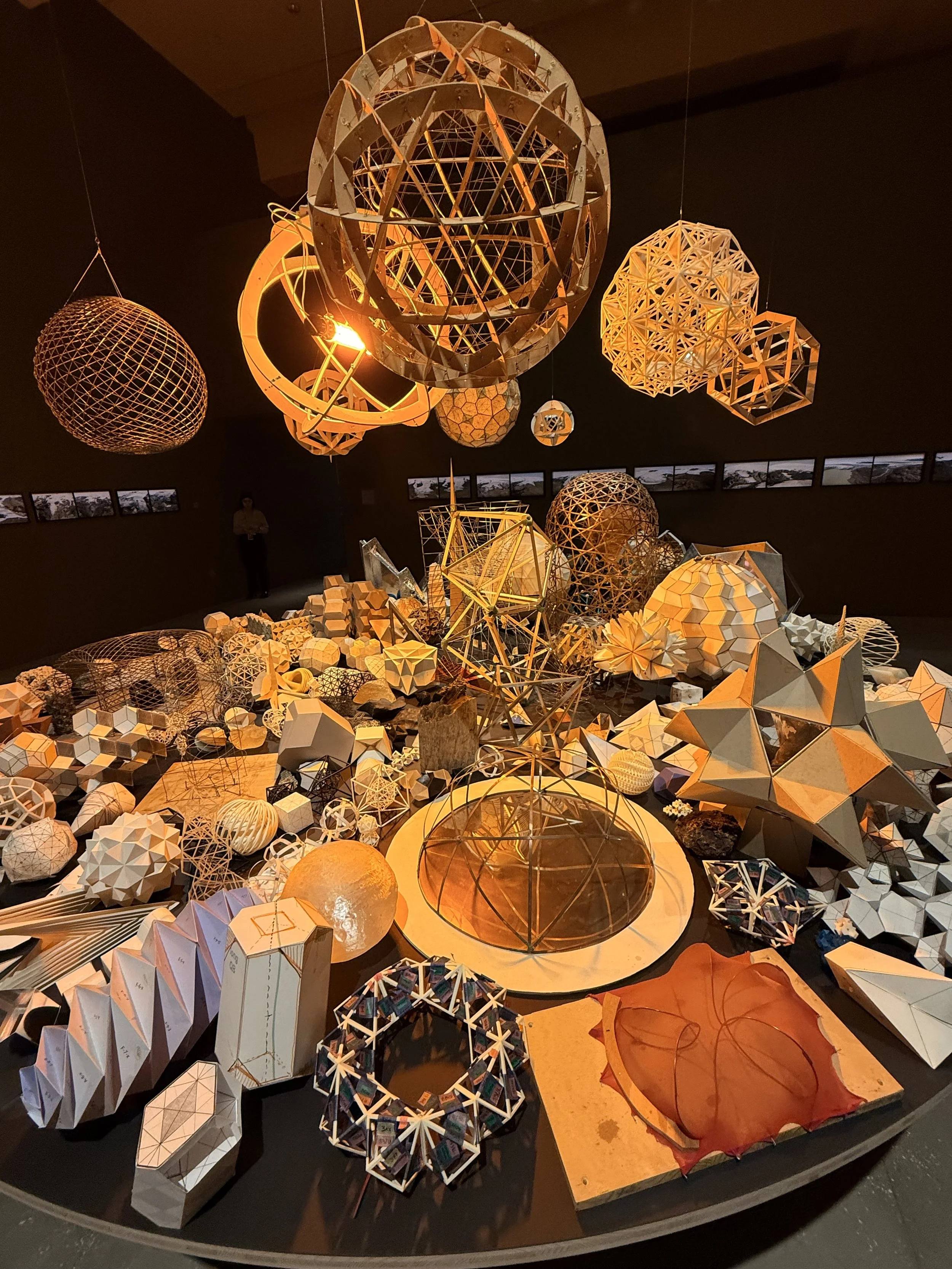
Nearby, a table overflows with an exuberant constellation of forms — spheres, polyhedrons, lattices, spirals, folded surfaces, glowing membranes, architectural models that look half mathematical diagram, half organic growth. This is Eliasson the tinkerer, the studio-engineer, the restless maker. The display hums with potential energy, as though each object is a prototype for a world not yet built. There’s a childlike delight in the diversity of shapes, a reminder that play and experimentation sit at the core of Eliasson’s practice.
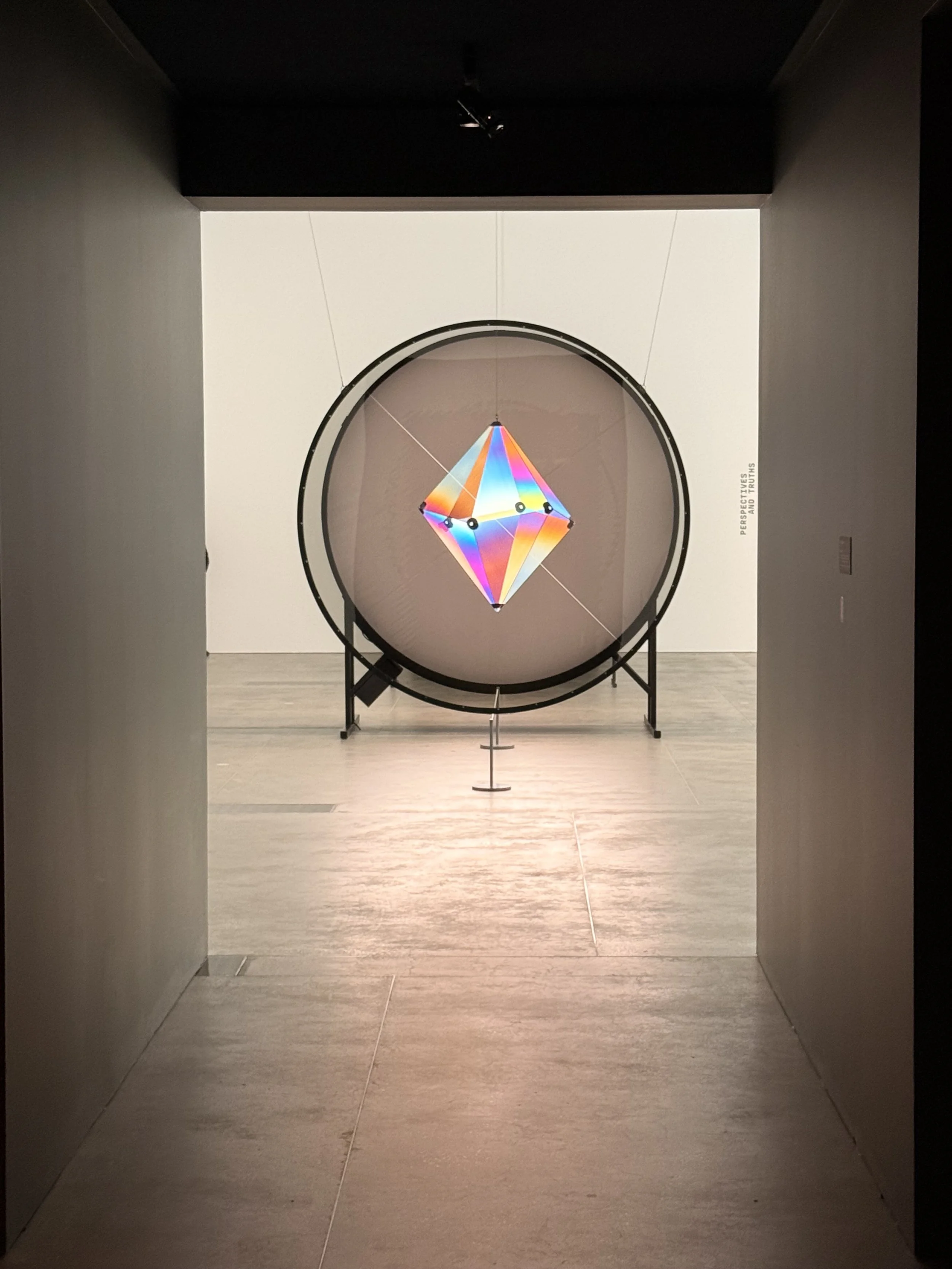
Then, through a corridor, comes a moment of magic. A glowing geometric sculpture — a prismatic diamond of refracted colour — hangs suspended inside a circular frame. Seen from afar, it is deceptively simple: a crisp form hovering in a white room. But as you approach, colours shift, surfaces dissolve into iridescence, and the interplay of shadow and light becomes hypnotic. It’s a work that rewards slowness. Eliasson always returns us to the basics: light + colour + space + movement = wonder.
Throughout the exhibition, Iceland is everywhere — not literally, but atmospherically. In the rocky terrains, the mirrored suns, the geometric obsessions, the sense of a world carved by wind and light. His photographic series of Iceland’s landscapes, shown here, feel like source code for the installations: stark, elemental, full of raw clarity.
What I love most about Presence is that it refuses passive looking. You have to move, adjust, recalibrate. You feel your own body’s data — temperature, balance, brightness, humidity — responding in real time. Eliasson reminds us that perception is never fixed; it’s negotiated moment by moment.
Two perennial QAGOMA favourites return: Riverbed, already mentioned, and The cubic structural evolution project, the endlessly rebuilt LEGO city. The latter continues to be a joyous social experiment — part architecture workshop, part utopian dream, part collective chaos. Kids build towers; adults pretend not to be invested in their own contributions but absolutely are.
In the end, Presence is less about what the artworks mean and more about what they do. They heighten your senses, reset your pace, and invite you to imagine other kinds of futures — planetary, urban, personal. It’s rare to leave an exhibition feeling physically changed, but that’s Eliasson’s gift: he enlarges your sense of the world by making you aware of your own presence within it.
Bugonia: Yorgos Lanthimos Goes Galactic (Sort Of)
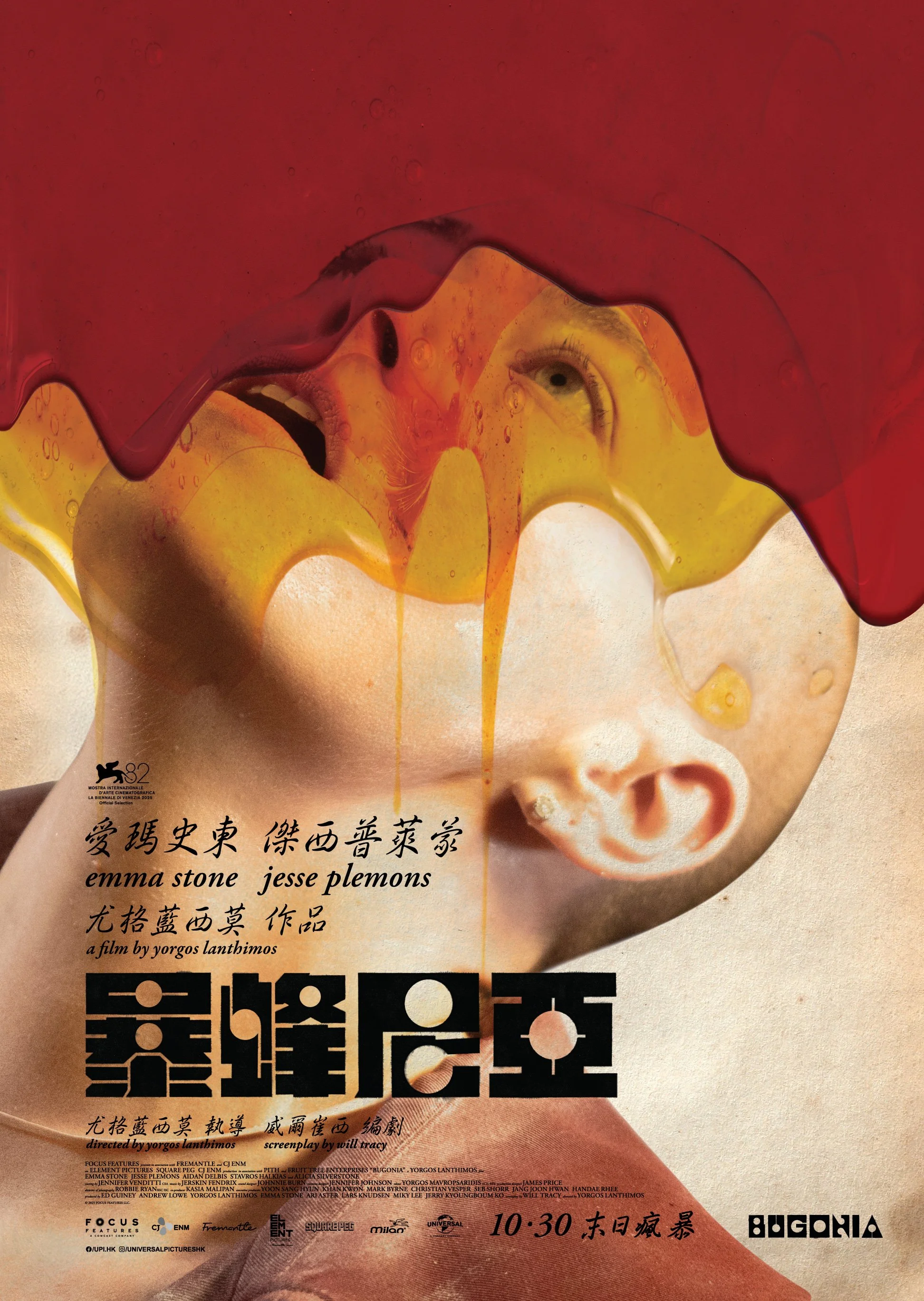
Yorgos Lanthimos has always made films where the real world tilts, fractures, and reforms into something that feels familiar but wrong in the most delicious way. With Bugonia, his English-language remake of Jang Joon-hwan’s cult classic Save the Green Planet!, he doesn’t so much modernise the original as rewire it—turning its manic conspiracy-energy into a polished, blackly funny descent into delusion, power, and paranoia.
Two young men kidnap a powerful CEO, convinced she’s an alien plotting Earth’s destruction. In another director’s hands this premise might lean too heavily on allegory, but Lanthimos uses it to probe the fragility of belief itself: how people build narratives around fear, how power attracts projection, and how conspiracy-thinking has become one of the dominant mythologies of our time. The humour, as always with Lanthimos, comes from the straightest possible delivery of the most unhinged convictions.
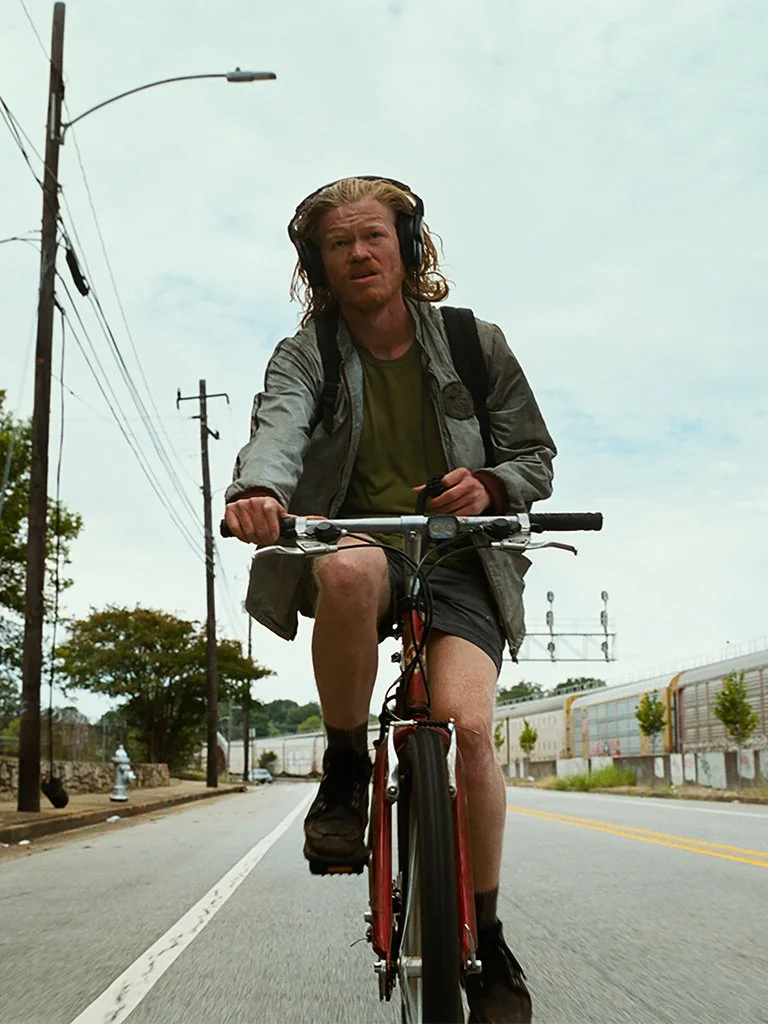
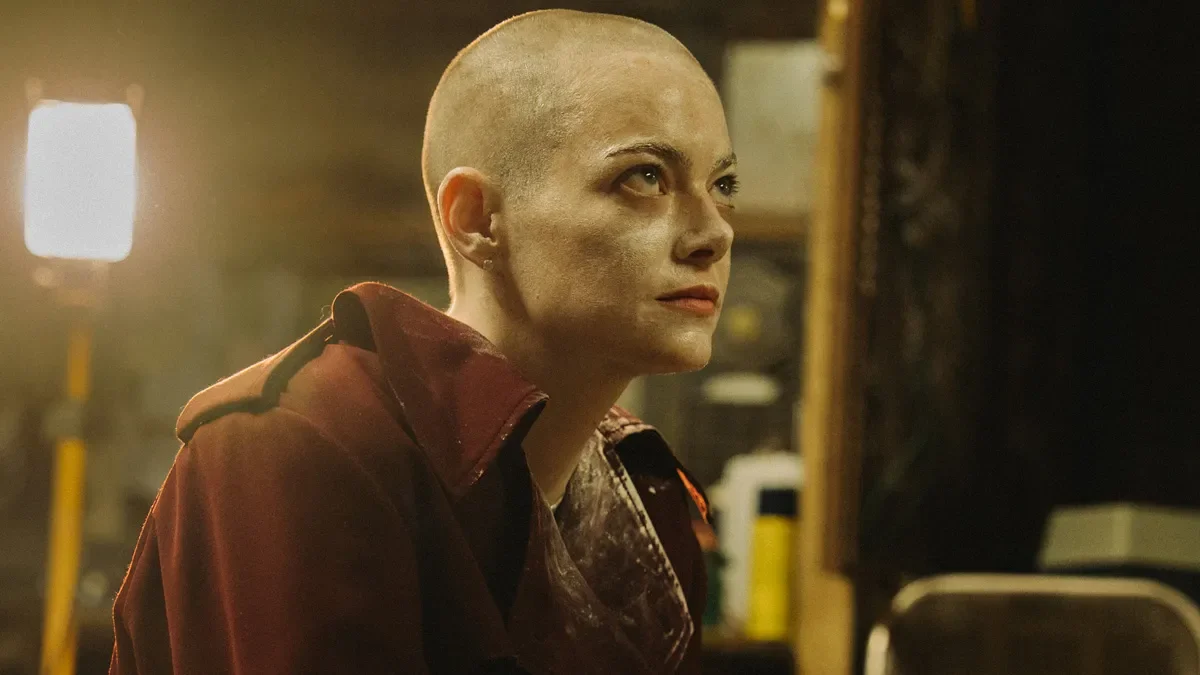
Emma Stone continues her mesmerising collaboration with Lanthimos—at this point she feels like his most precise instrument, capable of pivoting from brittle corporate serenity to reptilian menace in a single micro-expression. Jesse Plemons, too, is remarkable. There is a slow, haunted logic to his performance that allows the film to oscillate between comedy and deep discomfort without ever losing its footing. Together, they make the central power dynamic both absurd and frightening in equal measure.
What distinguishes Bugonia from Lanthimos’ earlier work is scale. With a production budget that dwarfs his previous films, he’s working with a broader visual and tonal palette. Scenes shot in High Wycombe and Atlanta have an antiseptic corporate gloss, while sequences filmed later on the Greek island of Milos introduce a kind of apocalyptic beauty. The film looks expensive, but Lanthimos never lets spectacle overwhelm the claustrophobic psychological engine of the narrative.
That said, the remake raises questions—particularly about how cultural specificity translates. Jang’s 2003 original was rooted in a very particular South Korean social tension: corporate capitalism, state violence, trauma, and fringe belief systems braided together. Lanthimos lifts the story into a more international corporate dystopia, which is sleek but arguably less jagged. What we gain in elegance we lose in raw cultural bite.
Still, the film works—often brilliantly. Lanthimos leans into the absurdity of modern conspiracy culture, but he also recognises its emotional voltage. The fear of being powerless in the face of institutional might, of sensing a system too big and opaque to understand, is profoundly contemporary. Bugonia captures that with unsettling clarity.
As the credits rolled, I found myself thinking about the original film’s messy sincerity versus Lanthimos’ clean, surreal geometry. Both have their place. But Bugonia feels like the right film for a moment when conspiracy theories spread faster than facts and CEOs are treated as either gods or invaders, depending on which podcast you’ve been listening to.
A stylish, deranged parable for late capitalism? Absolutely. And one that reminds us that the distance between faith and fear—the desire to believe in aliens or to expose them—is much smaller than we care to admit.
Devotion, Detail, and Daily Life: Seeing The God of Small Things
Queensland Art Gallery
20 September 2025 – 5 October 2026
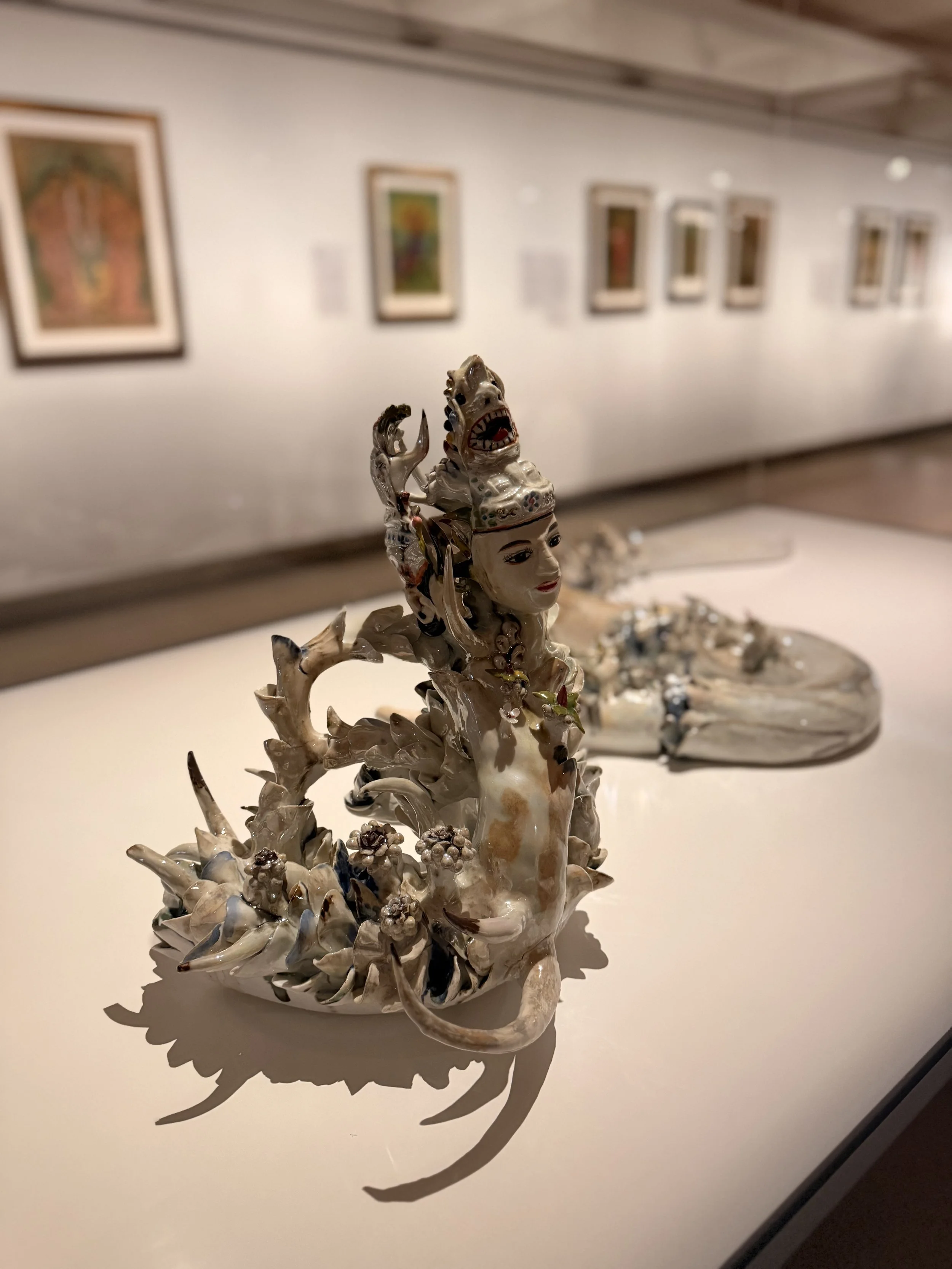
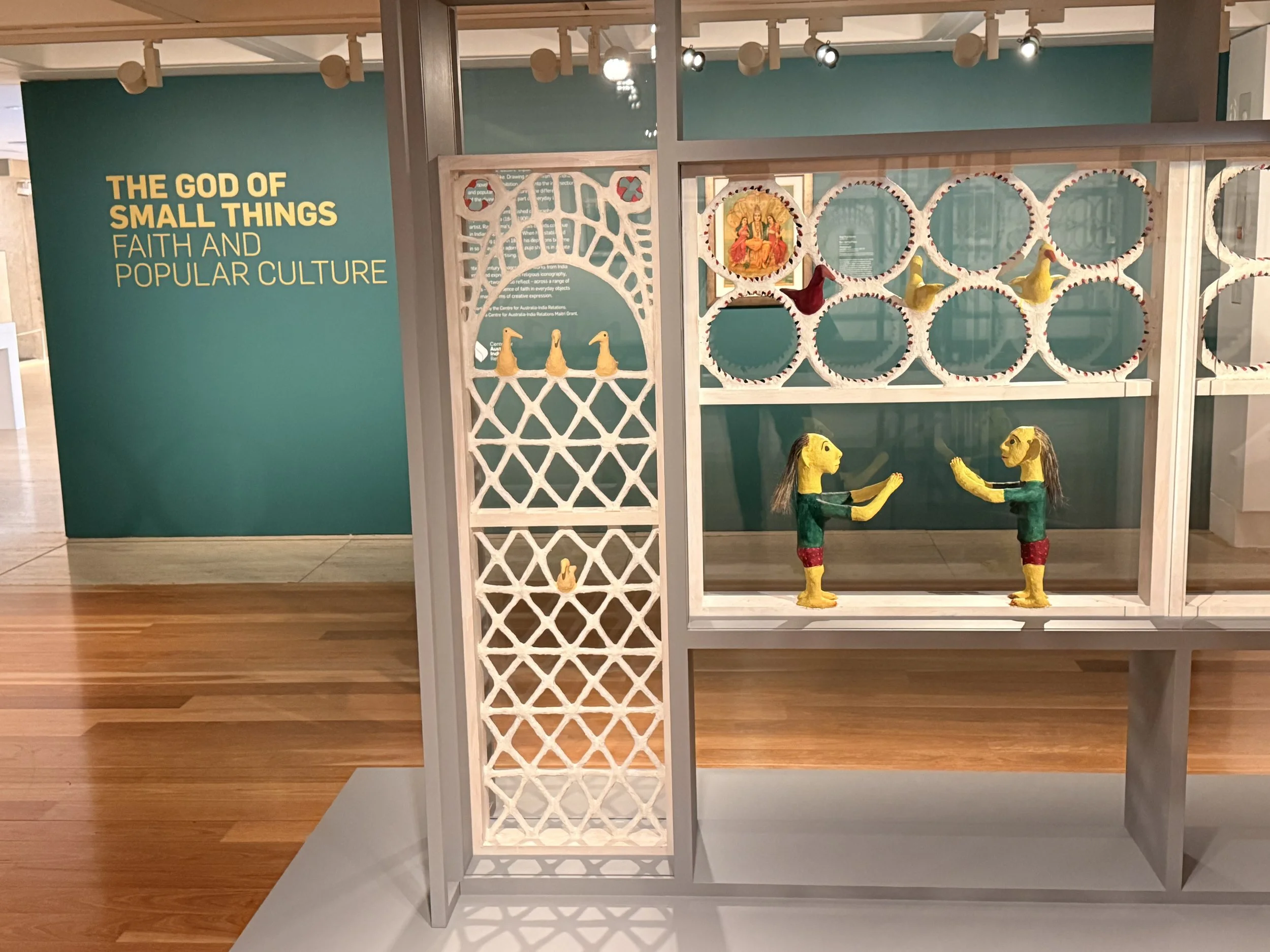
Walking through The God of Small Things: Faith and Popular Culture, I kept circling back to the idea that faith thrives in repetition and reinvention. Not the grand gestures of organised religion, but the accumulated weight of the small, the handheld, the domestic, the portable. The exhibition makes this argument elegantly, and for me it was the individual works—each with their own devotional histories—that grounded the show more than the overarching theme.
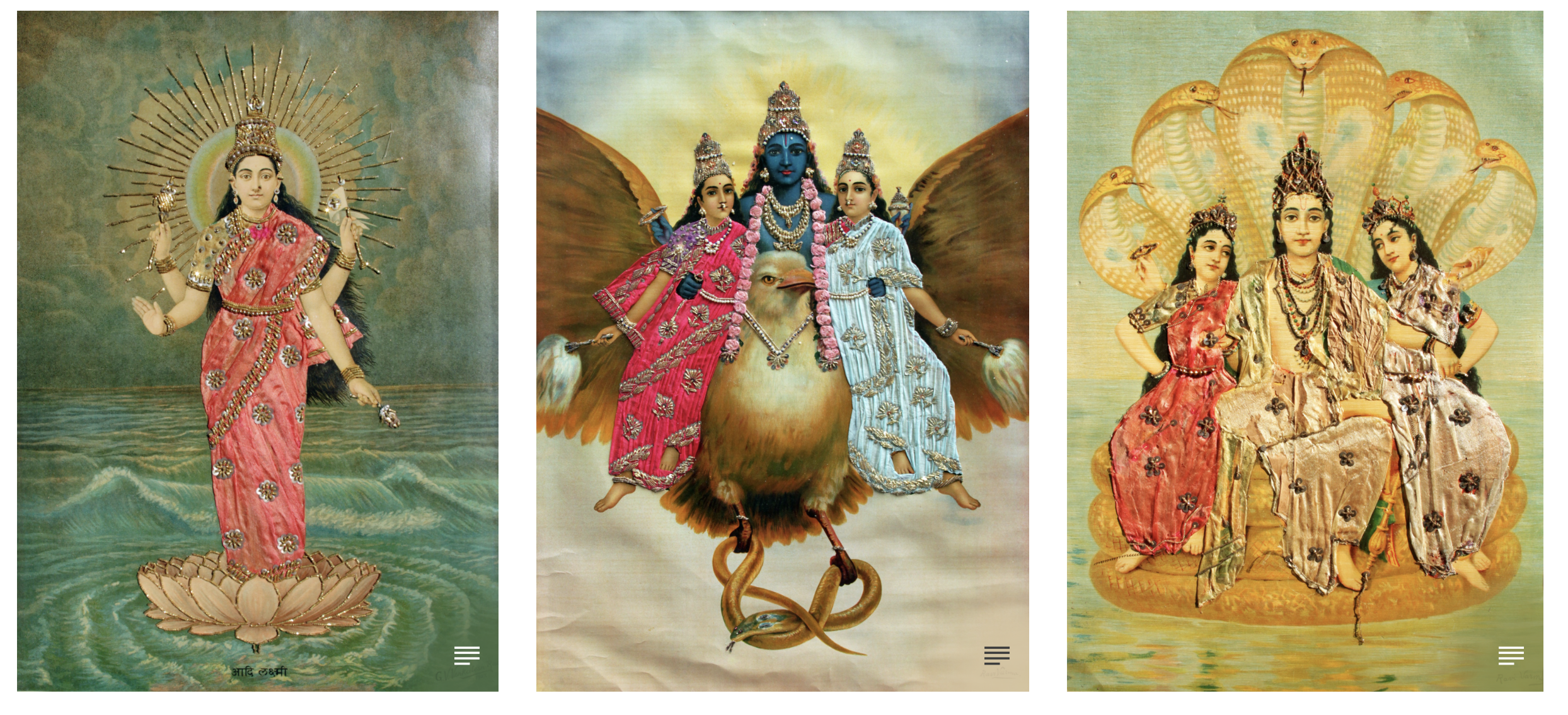
Raja Ravi Varma’s oleographs are the gravitational centre. Sheshnarayan, printed around 1910–20 and embellished with bundaki, shimmered under the gallery lights with a quiet authority. Varma’s portrayal of Vishnu reclining on the coiled five-hooded Shesha is already iconic, but seeing the surface detail up close—the dotted ornamentation, the fineness of the linework, the symmetrical harmony of the two Lakshmi figures flanking the deity—reminded me how intimately these images once lived with people. They were not artworks destined for the white cube; they were devotional companions pinned to walls, tucked into shrines, or bought from travelling print sellers. The label notes Varma’s combination of mythology and human detail, but what I felt most was the balance of grandeur and warmth: the divine rendered relatable, almost domestic, yet no less powerful.
This grounding in everyday divinity is echoed, unexpectedly, in Satyanarayan Suthar’s Untitled (Kaavad shrine) from 2015. The Kaavad is a portable storytelling shrine from Rajasthan, its hinged doors unfolding like a travelling theatre of gods, heroes, genealogies, and epics. The wall text outlines how the tradition has been passed from father to son, but standing before it I was struck by the intimacy of the form—its scale invites physical closeness, its sequential panels encourage patience. What delighted me was learning that contemporary Kaavad artists now insert cars, planes, and computers into the narratives. It’s such a perfect articulation of the exhibition’s thesis: that belief adapts to contemporary life, not the other way around. A tradition survives because it absorbs the world around it. The divine keeps expanding its vocabulary.
Taken together, these works anchor the exhibition in an understanding of faith as a lived, negotiated practice rather than a fixed iconography. And perhaps this is why the show resonated for me more deeply than similar thematic exhibitions: it doesn’t attempt to intellectualise belief out of existence. Instead, it honours the small gestures—the embellishment of a print, the unfolding of a wooden door, the ritual of looking—that keep devotional culture alive.
The broader curatorial gesture, pairing these historical devotional pieces with contemporary Asian works, works best when it allows the friction between eras to sit unresolved. Some of the contemporary works feel like mirrors held up to the devotional objects; others feel like subtle provocations, questioning what belief looks like in cities shaped by globalisation, media saturation, and digital iconography. The exhibition doesn’t force these relationships; it simply opens the door to them.
What I admired most, though, is the institutional commitment behind the show: QAGOMA’s conservation partnership with MAP Bengaluru. Varma’s oleographs are fragile survivors, and the decision to collaborate with Indian conservators rather than treat the works in isolation marks a welcome shift toward more ethical, transnational stewardship. The Maitri grant framing this partnership gives the exhibition a second life beyond the gallery—one rooted in shared practice rather than symbolic exchange.
If I have one lingering wish, it’s to see even more of the lived context of these objects—their scent of incense, their fingerprints, their wear. But perhaps that absence is the show’s subtle provocation: to remind us that while museums preserve devotional images, faith itself lives outside their walls.
Femininity in Extremis: Notes from the Exhibition
Confronting Femininity - IMA Brisbane
4 October–21 December 2025
Curated by Sal Edwards and Robert Leonard
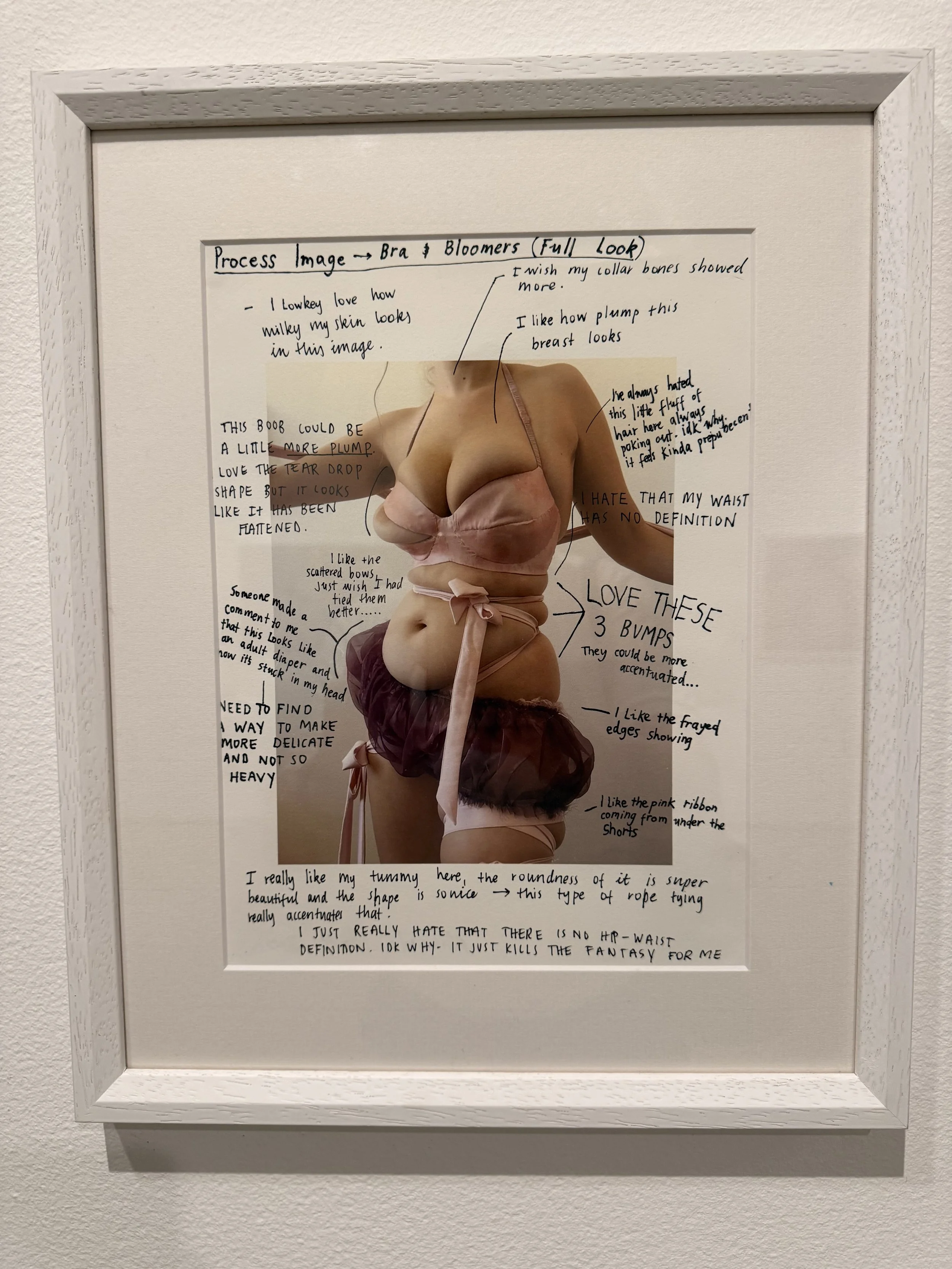
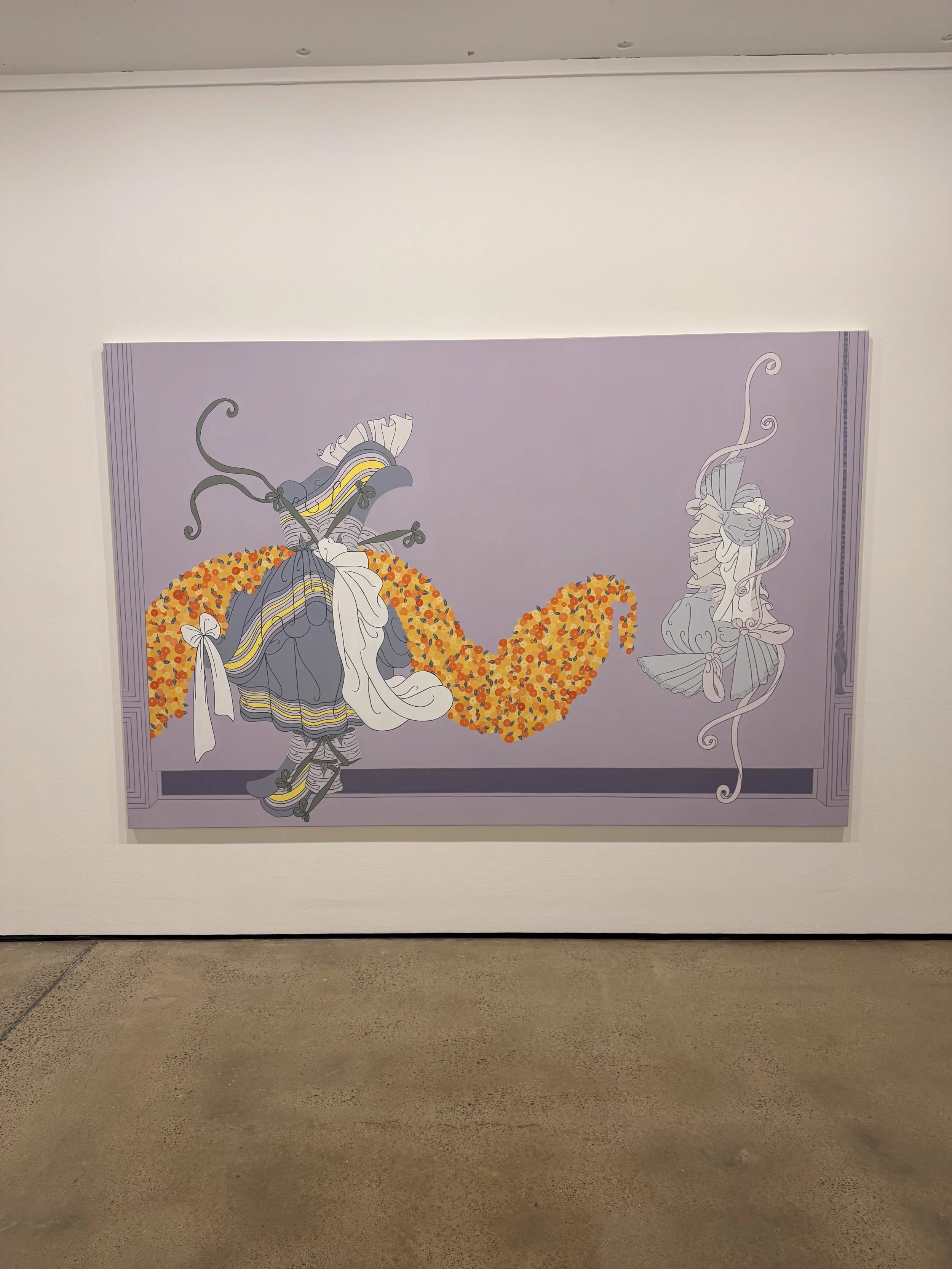
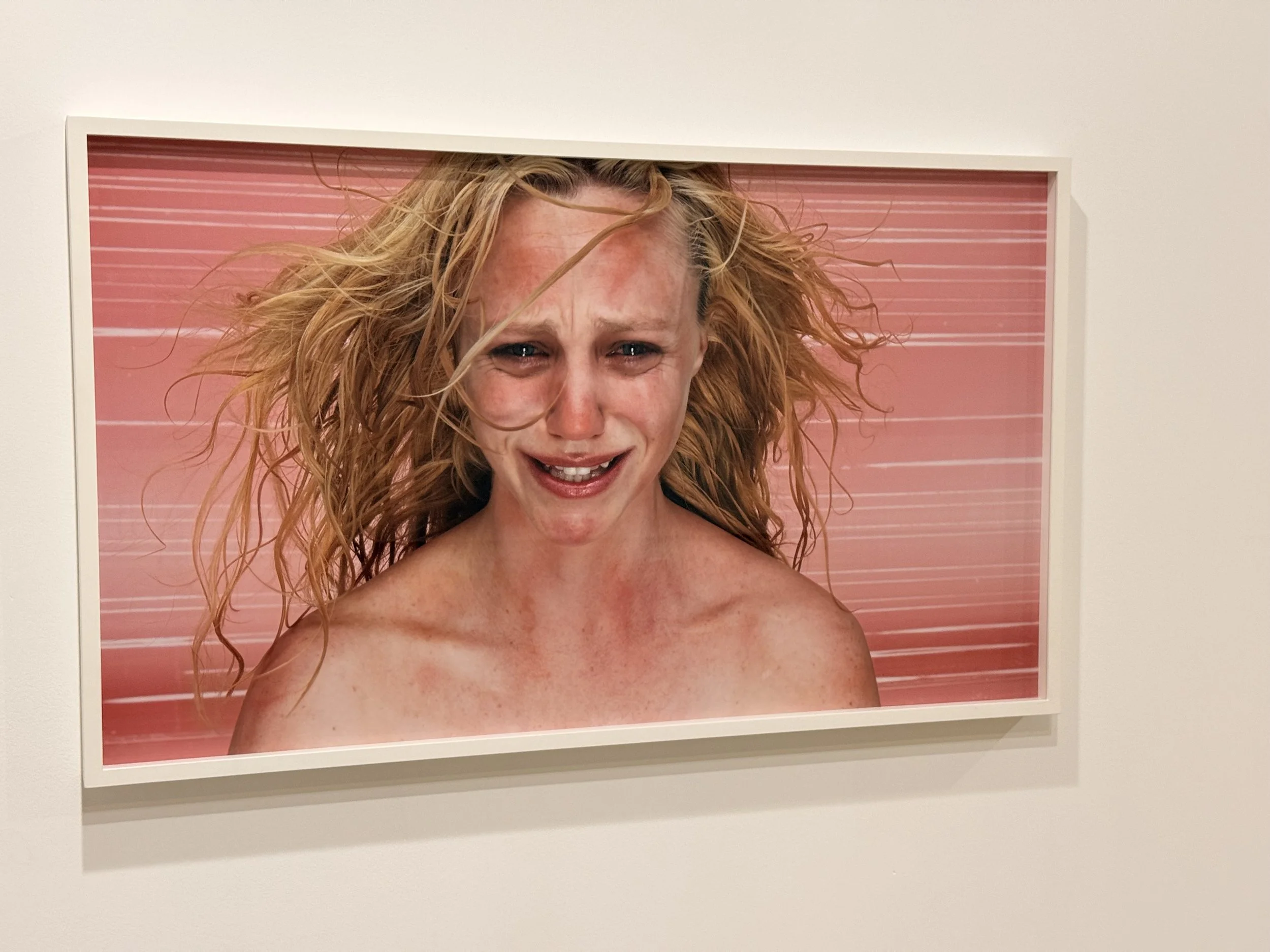
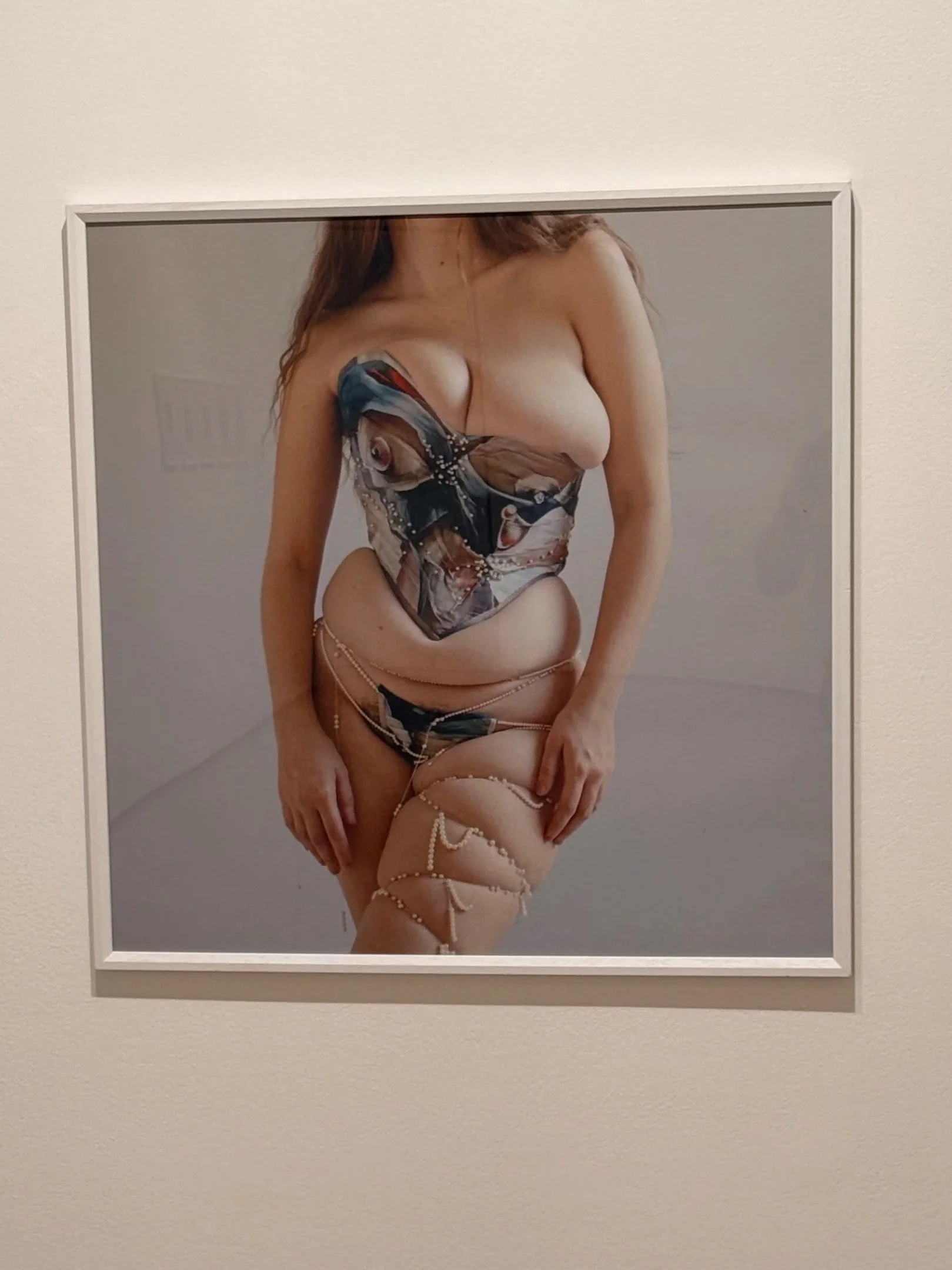
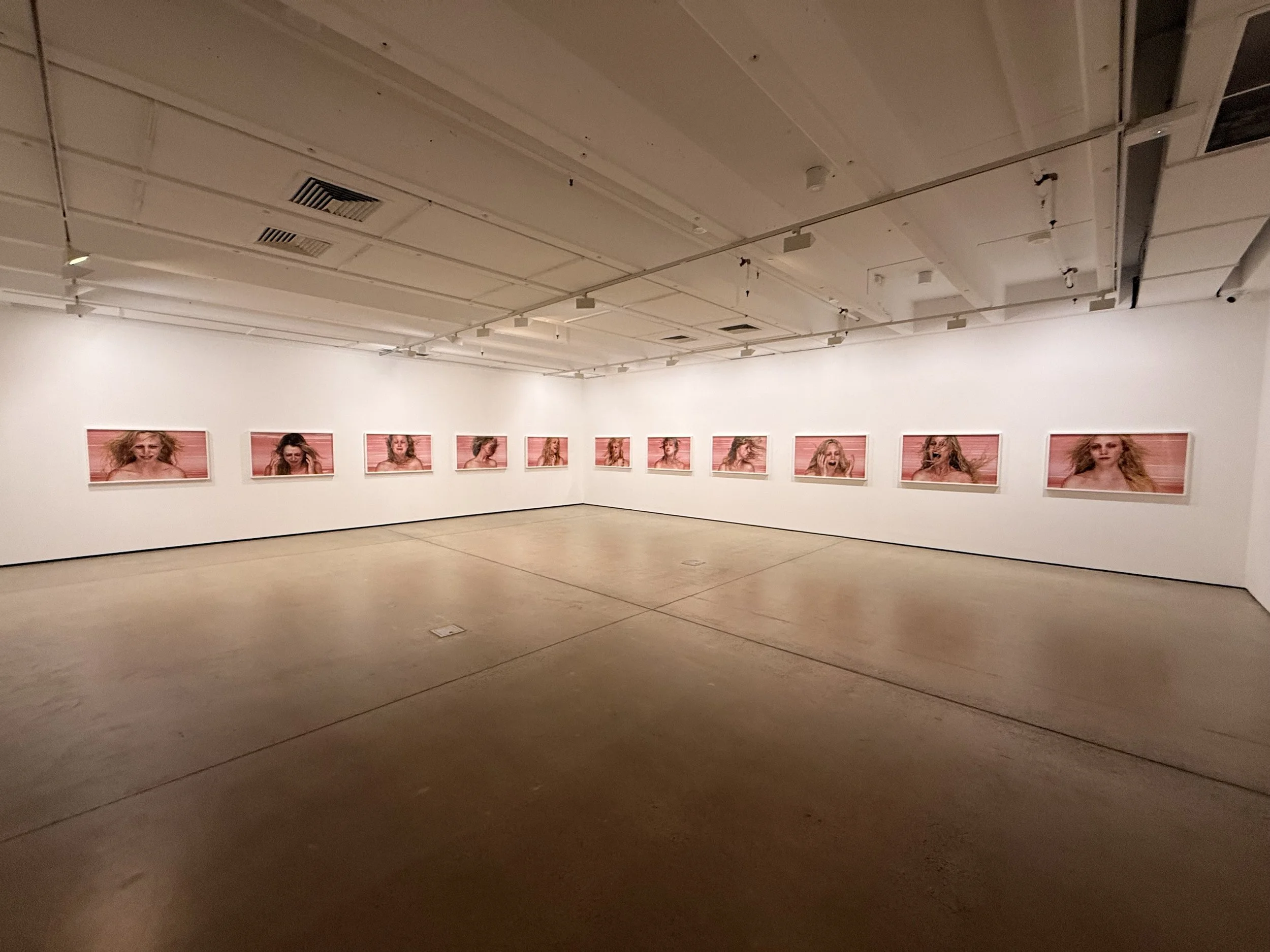
Confronting Femininity is an exhibition that immediately announces its confidence. Seeing the full suite of Rosemary Laing’s A Dozen Useless Actions for Grieving Blondes together is, frankly, a gift. Laing’s images have an almost architectural presence when read as a sequence—her blondes looping through their grief like a ritualised performance that is both sincere and knowingly theatrical. I’ve loved Laing’s work for decades, but this was the first time I felt the emotional temperature of that series as a kind of choreography: repeated, exhausted, and strangely tender. It was exhilarating to encounter such a strong show in Brisbane, one that isn’t afraid to place three uncompromising artists side by side.
Yet I found myself grappling with a nagging thought. For all the power of the work, why are we still relying on the female body as the primary battleground for conversations about femininity? It feels like a well-worn terrain and one I’m not sure we always need to keep returning to. This isn’t a criticism of the artists—each uses the body in a distinct and deliberate way—but rather a question about the frameworks we bring to women’s art. Perhaps the provocation now is not only to confront femininity but to imagine it beyond the body altogether.
Laing’s studio images, with their acidic pink backdrops and interchangeable blondes, have always played a clever double game: the grief is both too much and not enough. Are these women genuinely mourning, or are they performing the script society has handed them? Viewing the works en masse underscores the tension between what is felt and what is expected. They read like a chorus unable to break character, and that emotional ambivalence still holds extraordinary power.
Natalya Hughes, on the other hand, appears less interested in emotional nuance and more in the sheer pleasure of surfaces. Her reworkings of Erté’s illustrations feel like a deliberate shift away from her earlier critique of male modernist depictions of women. Here, she embraces hyperfemininity with a kind of intellectual glee. By removing the bodies and letting the garments float free—corsets, bows, and ruffles forming new architectures—Hughes invites us to indulge in femininity as an aesthetic system rather than a gendered constraint. There is joy in this doubling-down, even if part of me wonders whether pleasure alone is enough to destabilise the codes she’s referencing.
Michaela Stark’s contribution pushes the conversation back into the realm of lived experience. Her use of her own body isn’t simply autobiographical; it’s strategic. The tension between desire, discomfort, and agency is right there in the seams. Stark’s photographs, particularly the early Second Skin works, remind us that the body is endlessly rewritable but not infinitely cooperative. The fact that some were shot on her phone for Instagram matters—they signal a refusal to let the fashion industry dictate what bodies are worth looking at. What I admire most in Stark’s work is her ability to be both vulnerable and confrontational at once.
Confronting Femininity brings these three practices together with sharp curatorial intent. Still, I leave with an unsettled feeling—a curiosity about what a future exhibition might look like if femininity were approached less as something inscribed on the body and more as something that exists in language, gesture, labour, community, or even climate. Maybe this exhibition is a necessary step in that direction: a reminder of where we have been and a prompt to imagine what comes next.
Elastic Hearts: Raw, radiant and unrelentingly human
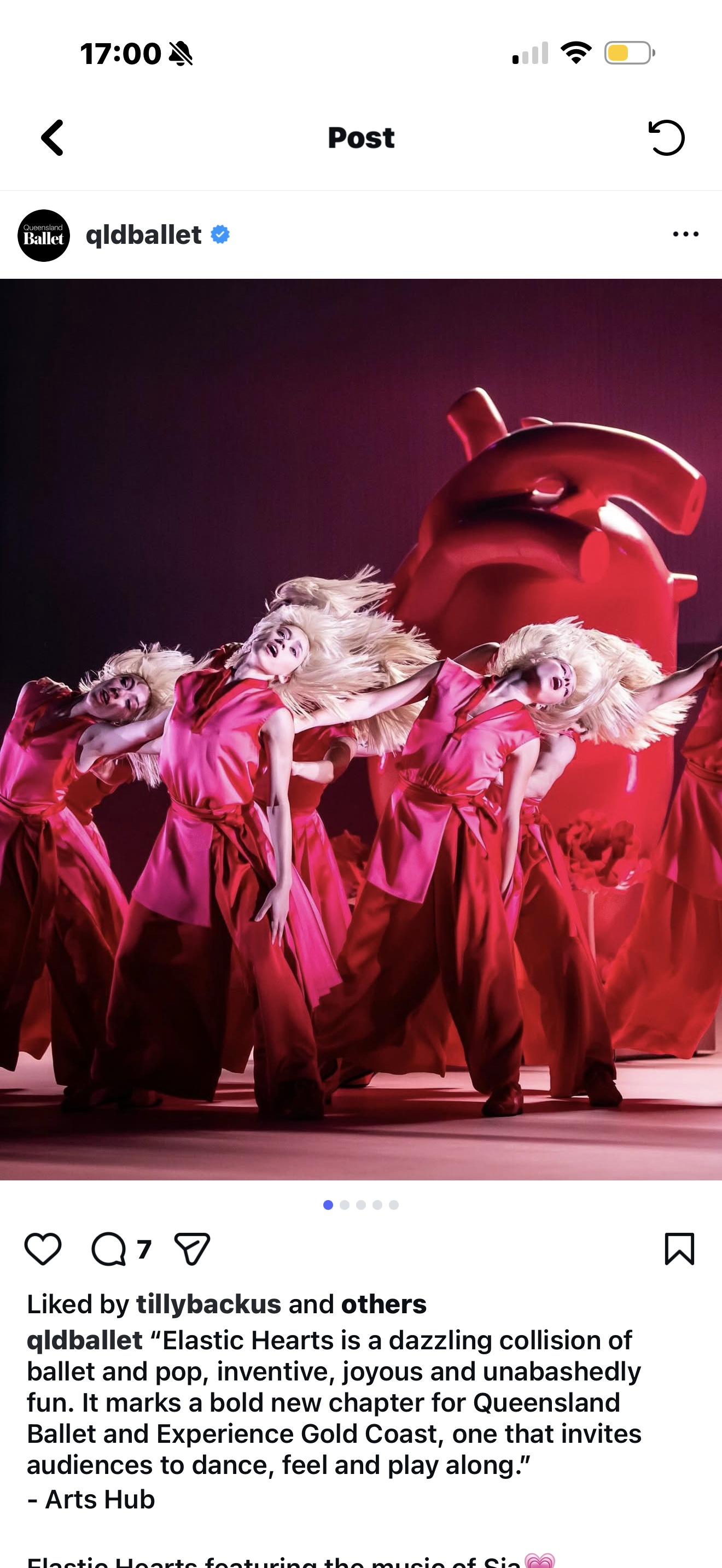
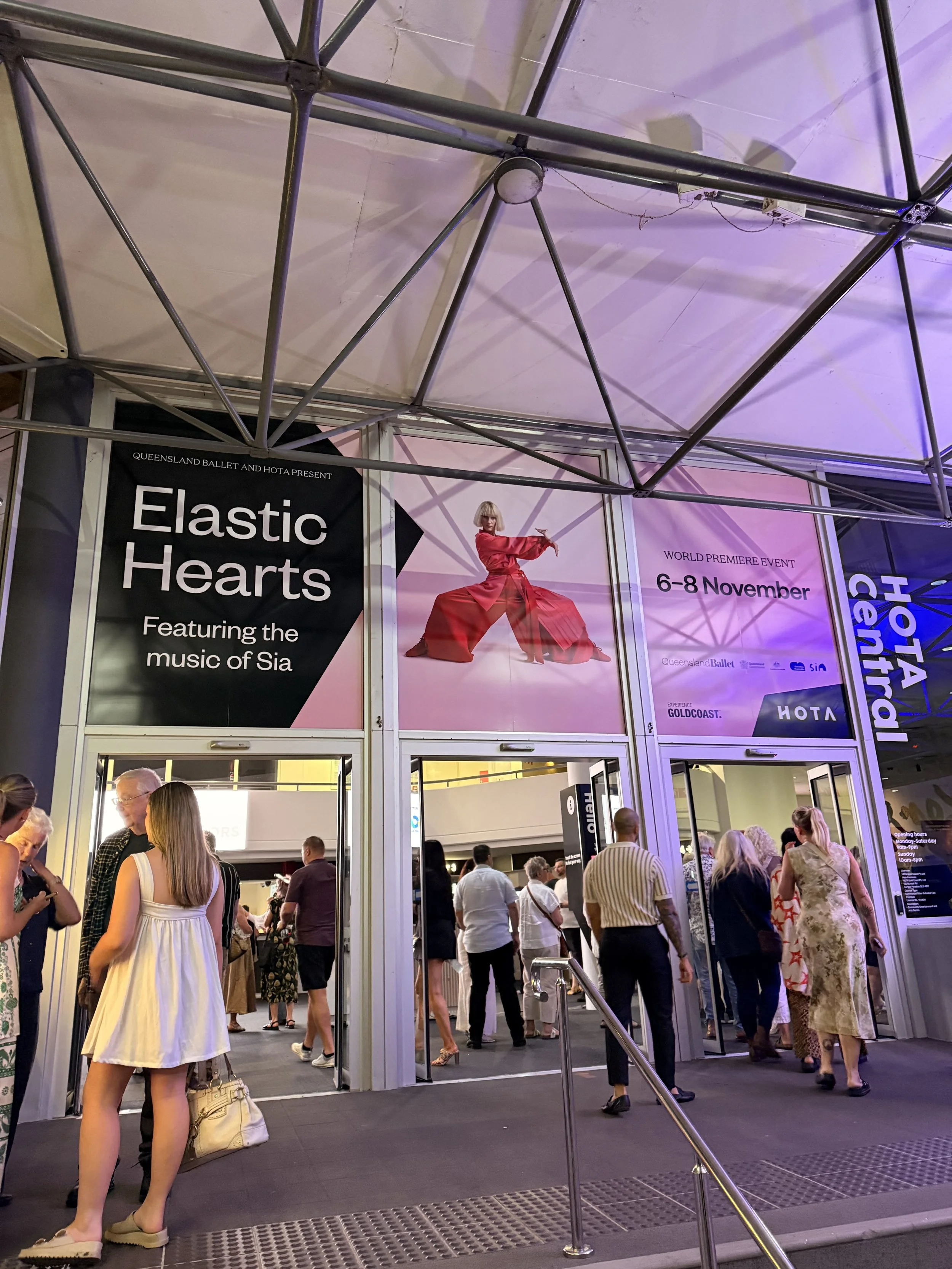
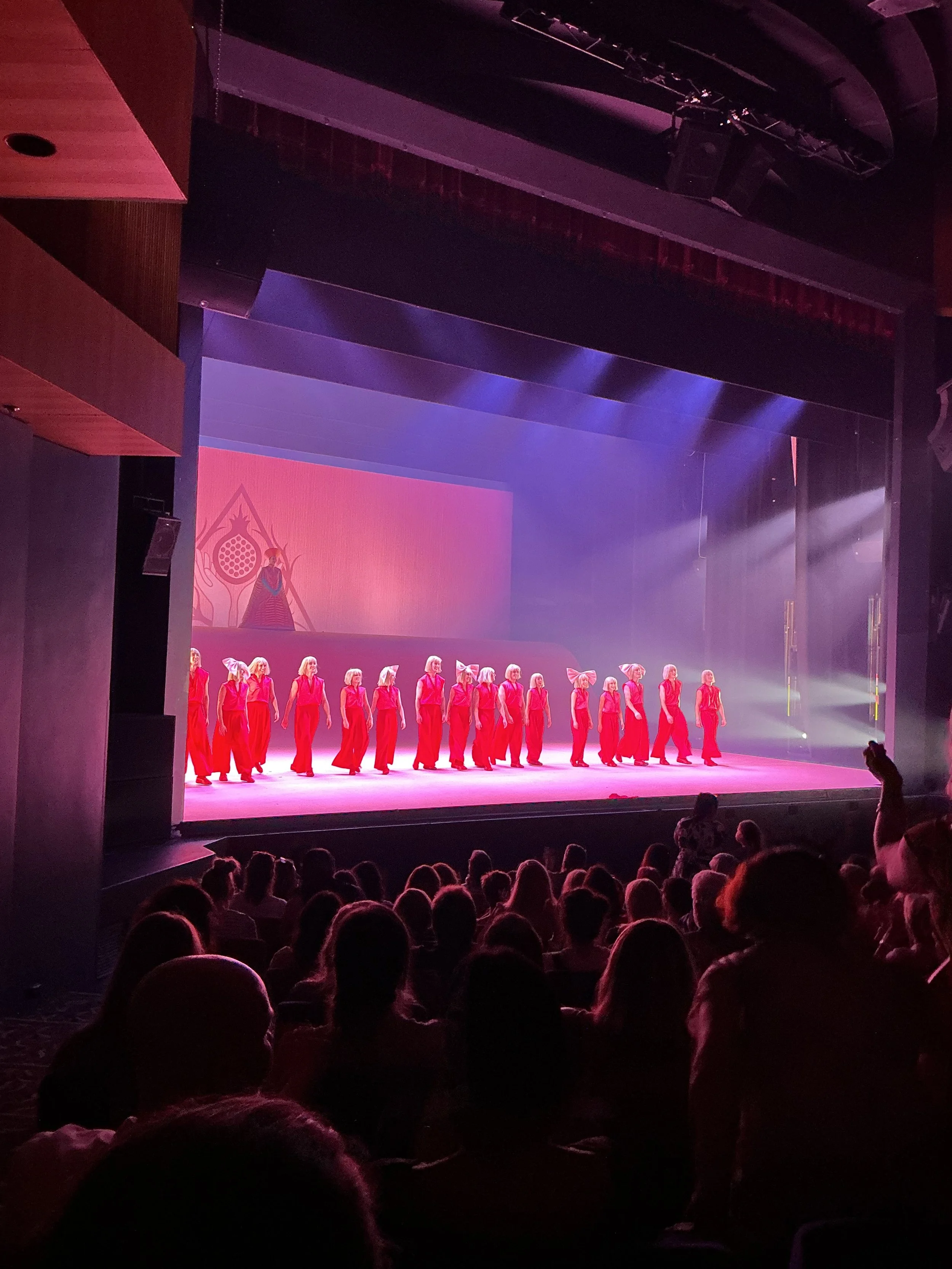
Internationally acclaimed choreographer Garry Stewart has joined forces with Queensland Ballet to create Elastic Hearts, a visually arresting new work set to the music of Sia, reimagined through a sweeping orchestral score by Elliott Wheeler and recorded by Queensland Symphony Orchestra. At its centre is Gaia, the goddess of the Earth, whose journey unfolds like a living myth: cycles of destruction, renewal, and transformation made visceral through movement, light, and design. Across the work, forests rise, swings arc across the stage, ramps shift with seismic intention, and finally a monumental pink heart blossoms in a gesture that is both delicate and defiant. It is a world that breathes with its dancers.
I have followed Garry Stewart’s career for decades—long before his tenure at Chunky Move—ever since meeting him during his time as choreographer-in-residence at the Canberra Contemporary Dance Studio in the 1990s. His work has always carried a rare precision and a fierce emotional intelligence, and Elastic Hearts continues that lineage while opening a new chapter. This is Stewart at his most expansive and contemporary, partnering seamlessly with Queensland Ballet’s exceptional ensemble.
The dancers are superb: energetic, technically exacting, and committed to storytelling that is emotional without ever tipping into kitsch. Stewart’s physical vocabulary finds a natural home within the company’s strength, and together they craft a narrative that feels urgent and utterly of this moment. Costumes shimmer between the earthly and the celestial, extending the sense that we are watching something both ancient and deeply modern.
Wheeler’s orchestral re-scoring of Sia’s iconic music is sublime—lush, cinematic, and full of unexpected tenderness. At times it feels like the score is breathing beneath the dancers’ feet. I would happily purchase a recording if one becomes available; it deserves to live beyond the theatre.
The only jarring element of the evening had nothing to do with the production itself: audience members rustling chip packets during key quiet sequences. A very Gold Coast behaviour, perhaps, but one that momentarily punctured the otherwise immersive atmosphere.
Elastic Hearts premiered on the Gold Coast but will move to a full season in Brisbane in 2026, where I expect it will find an even larger and more attentive audience. It is emotionally charged, visually spectacular, and ultimately a celebration of humanity’s ability to bend, adapt, and endure. Stewart and Queensland Ballet have crafted a work that feels both mythic and intimate—an artwork that vibrates with life.
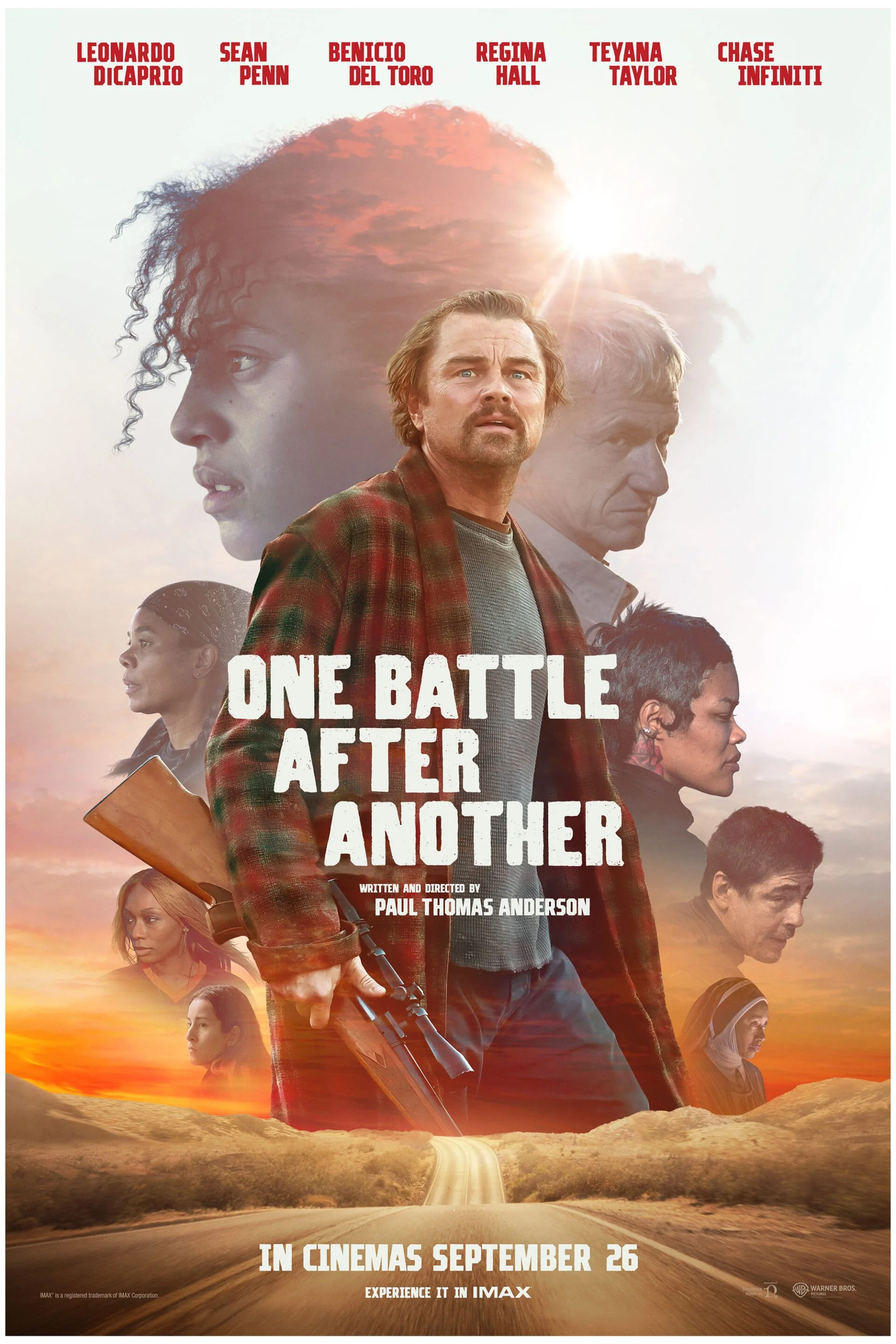
Two Sides of the Screen: One Battle After Another and Roofman
Across two cinemas and two very different worlds, I found myself drawn into stories about survival — one political, one personal — both anchored by performances that hit harder than expected.
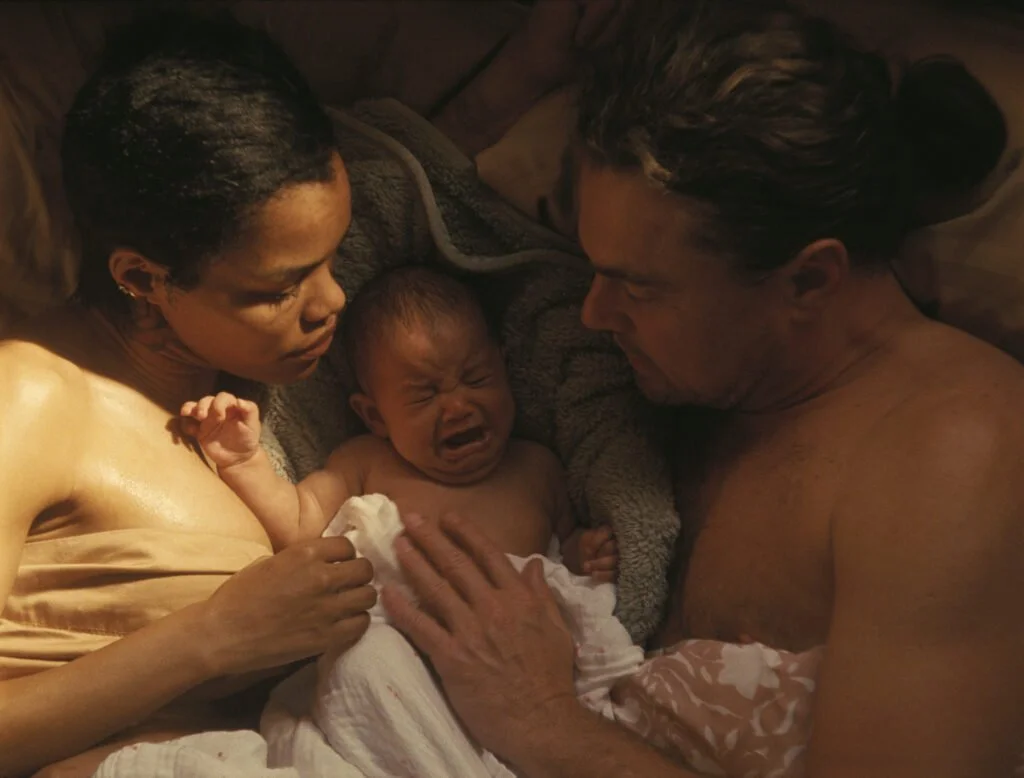
At Brisbane’s Palace James Street, One Battle After Another felt like a film made for this exact moment. Directed with precision and fury, it’s a tightly wound drama about power, protest, and moral fatigue — the kind of film that dares to ask whether fighting for what’s right can ever truly end. Sean Penn, in one of his most compelling roles in years, brings a raw intelligence to a character teetering between idealism and burnout. Opposite him, Teyana Taylor is magnetic — fierce, grounded, and impossible to look away from.
There’s a sense that the film knows exactly where we are culturally — caught between outrage and exhaustion — and it meets the audience there. Its dialogue crackles with relevance, its visuals are restless and urgent, and the emotional weight feels earned rather than forced. It’s not an easy film, but it’s one that leaves you alert, unsettled, and oddly hopeful. Everyone should see it.
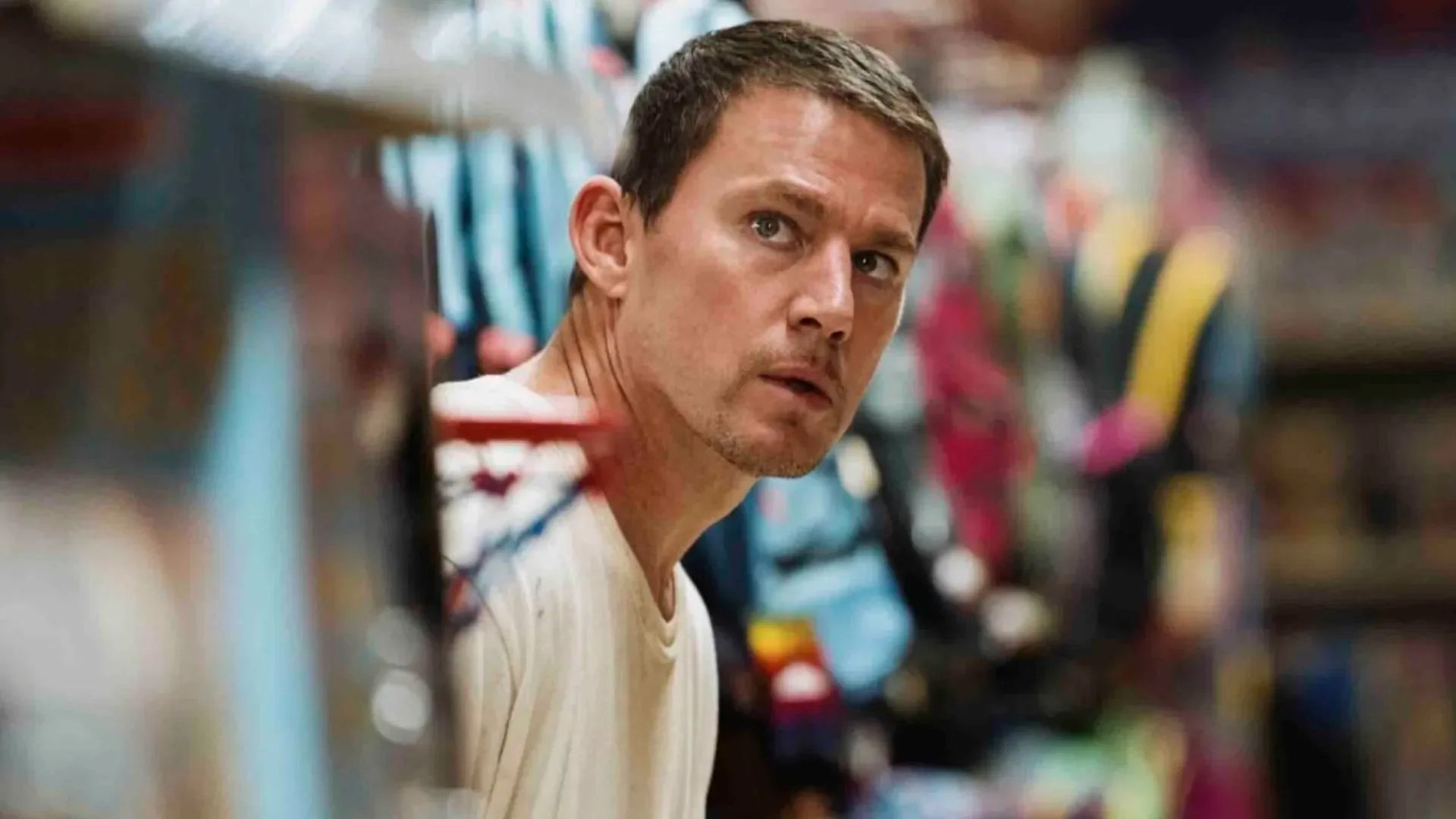
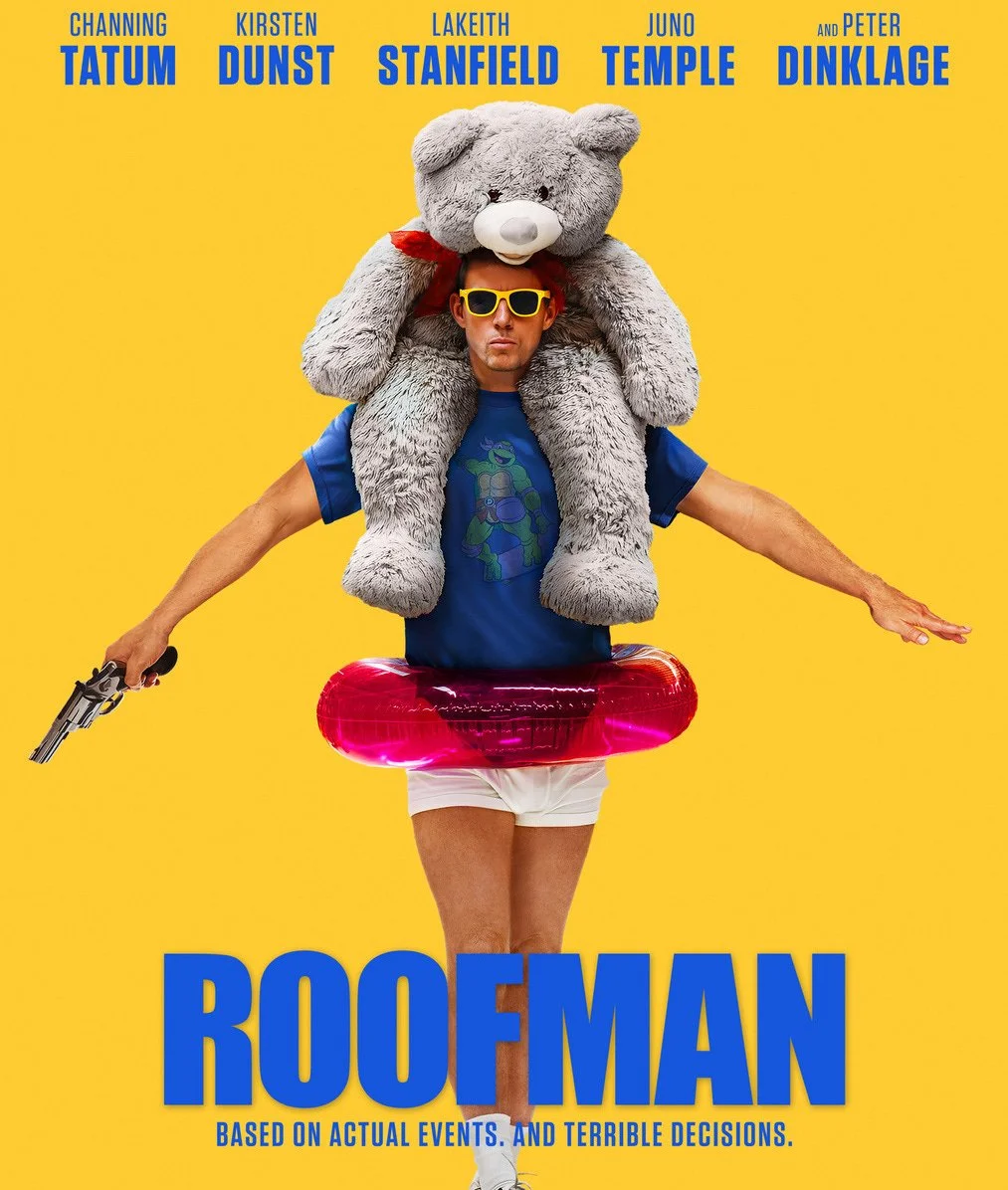
A few days later, at HOTA Cinema on the Gold Coast, I watched Roofman, a completely different experience but just as satisfying. Channing Tatum stars as a down-on-his-luck tradie who becomes an unlikely folk hero after an act of impulsive bravery goes viral. What could have been a throwaway comedy turns into something surprisingly tender — a look at class, masculinity and what happens when ordinary people are thrust into extraordinary moments.
Tatum has never been better: his timing is sharp, but there’s vulnerability underneath the swagger. The film’s pacing is loose in parts, but its heart is steady, and by the end, Roofman earns every bit of its emotional payoff.
Together, these two films bookend something about the present mood — the tension between fighting battles that feel endless and finding dignity in small, unexpected victories. One speaks to the times we’re living through; the other reminds us that decency and humour still matter. Both, in their own ways, stick with you long after the credits roll.
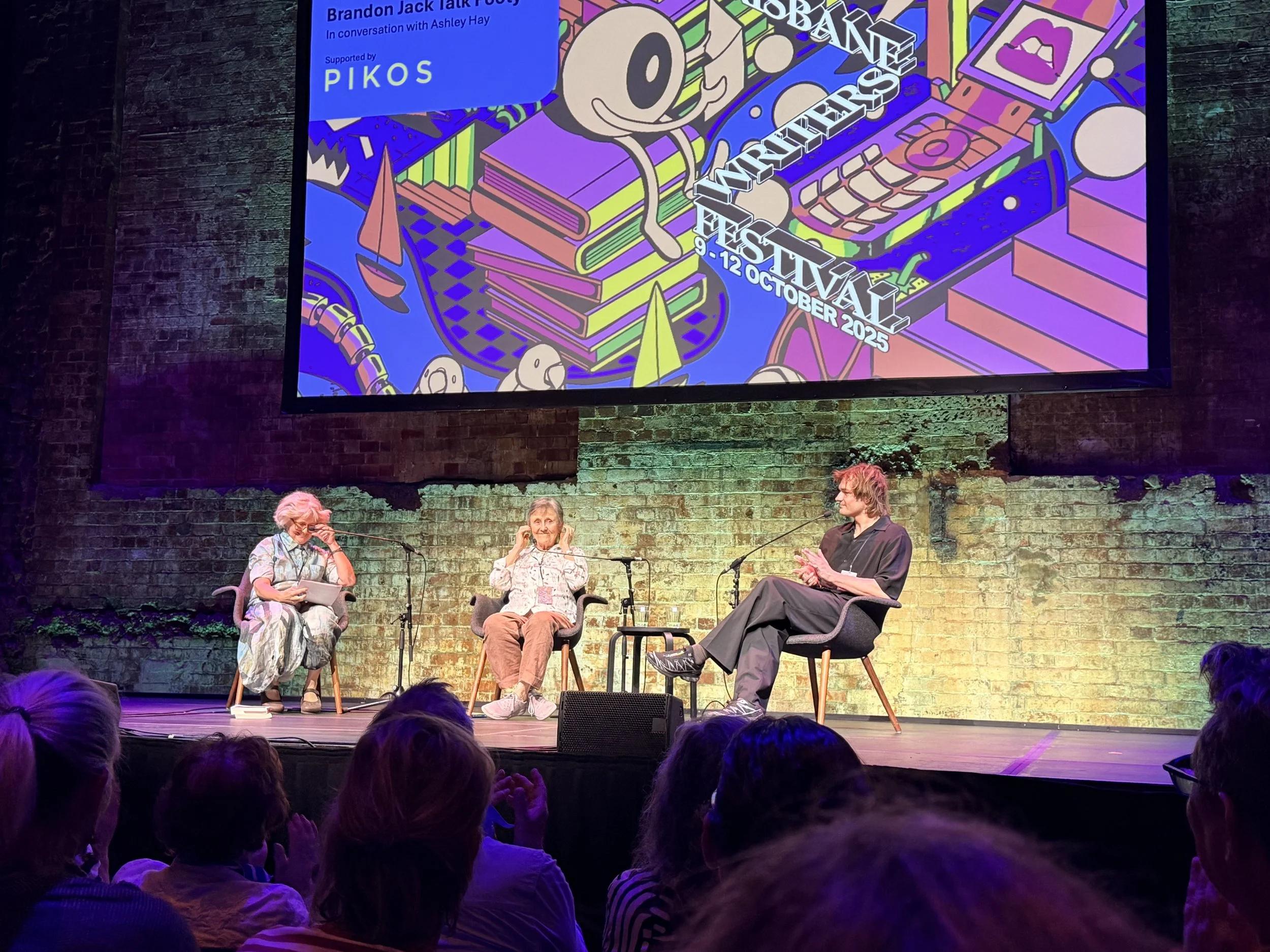
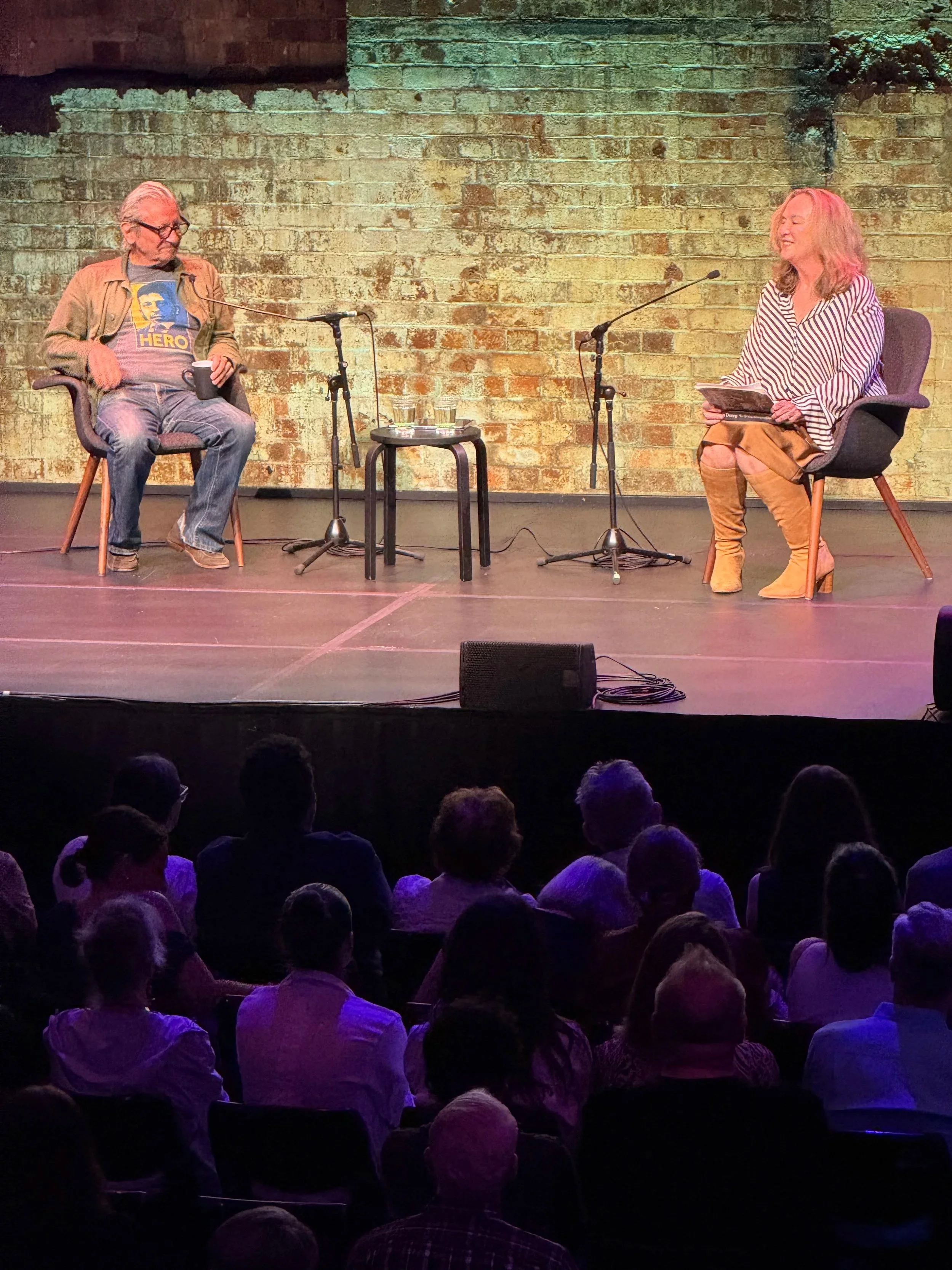
Griffin Dunne and Helen Garner light up the Brisbane Writers Festival
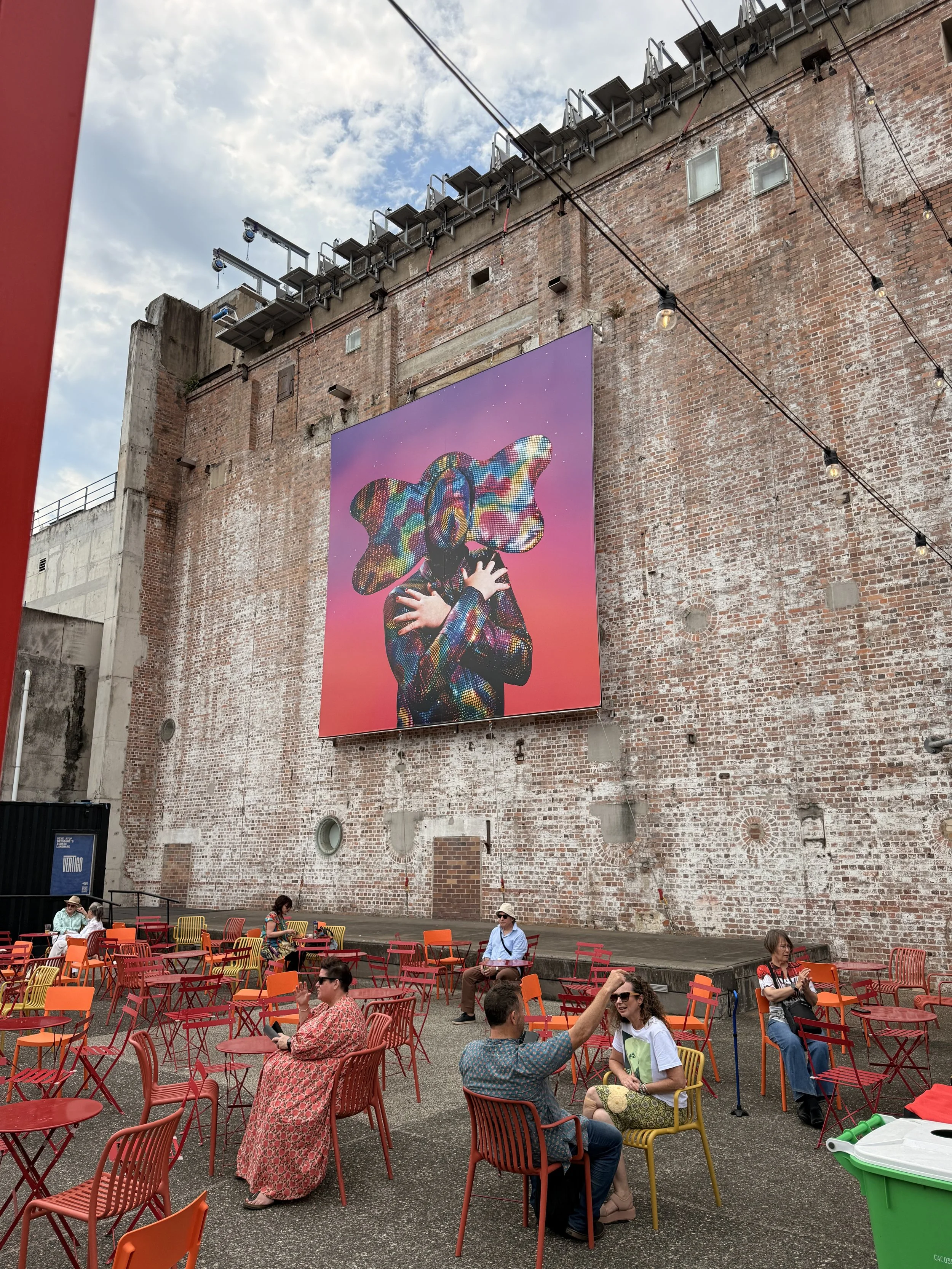
It was a bright spring afternoon at the Brisbane Powerhouse — jacarandas out, the river busy, and the annual Writers Festival in full stride. I saw two sessions that couldn’t have been more different but somehow shared the same theme: how to live honestly with what life gives you.
First up was Griffin Dunne in conversation with Frances Whiting. For anyone who grew up in the 1980s, Dunne’s face is instantly familiar — especially to me. As a 14-year-old queer kid in the country, I watched Madonna’s Who’s That Girlover and over, and Dunne was the kind of leading man who felt slightly left of centre: charming, vulnerable, funny. Later I discovered his father, Dominick Dunne, whose Vanity Fair columns I devoured for their mix of gossip, justice and grief.
On stage, Dunne talked about that world with an ease that only comes from having lived through its highs and heartbreaks. He spoke about the murder of his sister, the long shadow of Hollywood, and the way grief forces people to either shut down or rebuild. What stayed with me most was the idea of reinvention — how both he and his father managed to reshape their lives after loss.
Helen Garner’s conversation with Brandon Jack, moderated by Ashley Hay, had a different energy — gentler, but just as sharp. Garner was in good form: warm, funny, and clearly enjoying herself. She treated Jack like a friend and a mentee, guiding him through a talk that touched on morality, writing, and the search for decency in modern life.
Jack was articulate and serious, his polished confidence balanced by Garner’s dry humour and lived experience. Together they represented two generations of Australian writers who care deeply about truth — even when it’s uncomfortable. Hay kept the pace even, offering context and calm when the conversation wandered into more personal territory.
Between sessions, I sat by the river at Bar Alto, eating octopus and flatbread with a glass of Clare Valley riesling, watching festivalgoers drift past. The atmosphere was relaxed — the kind of civic confidence that Brisbane has quietly built over the past decade.
By the time I walked back to my car through New Farm Park, under the purple clouds of jacarandas and past families picnicking in the heat, I felt that same mix of reflection and ease I’d heard in both talks. For all the fame and intellect on stage, the message was simple: keep moving forward, keep paying attention.
Love Stories at HOTA: Trent Dalton’s theatre of the heart
Walking out of HOTA after Love Stories, I felt buoyed — not just by the sheer warmth of the production, but by the pleasure of seeing a major Australian work staged with such generosity and skill. It’s not often that a play built entirely around sincerity succeeds, but this one largely does. Adapted by Tim McGarry and directed by Sam Strong from Trent Dalton’s 2021 collection of real encounters, Love Stories translates the optimism of the original project into a moving, theatrically satisfying evening that manages to avoid the sugary excesses it flirts with.
There are moments, inevitably, when Dalton’s view of love veers toward the sentimental — his belief in human goodness, in the redemptive power of kindness, can feel almost old-fashioned. Yet the production’s intelligence lies in how deftly it steers through these risks. The script and performances keep sentiment from curdling into saccharine, turning what might have been a collage of tear-jerking anecdotes into something cohesive, modern, and quietly profound.
The ensemble cast is superb. Each performer shifts through multiple characters — grieving partners, hopeful lovers, scientists, parents — with precision and empathy. What might sound like a recipe for emotional whiplash instead unfolds as a kaleidoscope: small lives refracted into a universal portrait of love’s endurance. A particularly effective device comes at the end, when the real people whose stories inspired the play appear on screen. It’s a simple gesture, but it closes the circle between art and life beautifully, grounding the theatricality in lived experience.
Visually, Love Stories is striking without being ostentatious. The integration of video and projection — so often a distraction onstage — is handled with rare sensitivity. The AV design adds depth and rhythm, guiding the audience through the shifting worlds of Dalton’s storytellers. It also underscores the project’s journalistic origins: a writer sitting at his sky-blue Olivetti typewriter in King George Square, listening to strangers. At times, the interplay of image and performance evokes the intimacy of documentary theatre, suggesting that a film or television adaptation could work equally well.

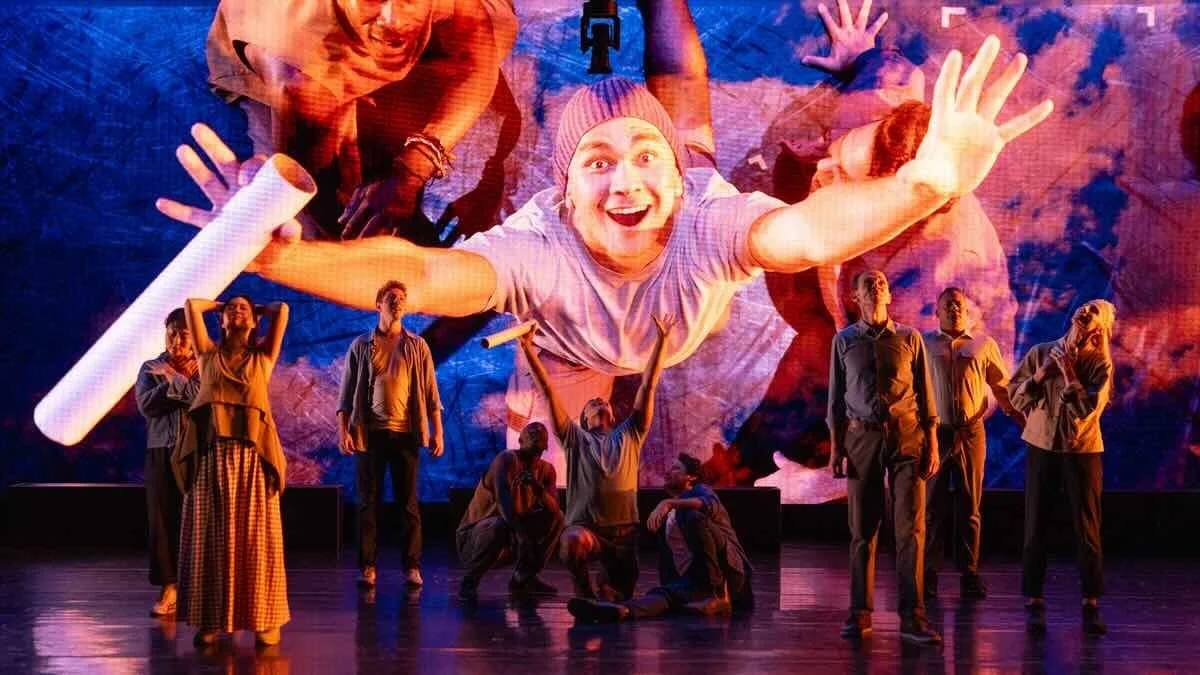
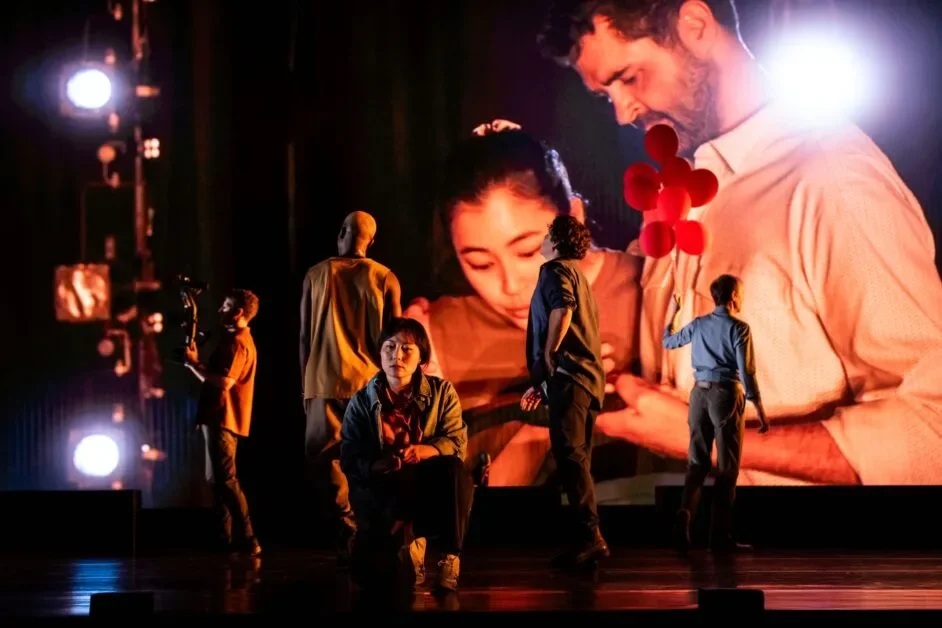

The Gold Coast audience responded warmly, filling the medium-sized theatre with an easy local enthusiasm. The venue’s casual atmosphere — audience members munching chips in the front row — jarred slightly with the work’s emotional delicacy, but it also spoke to the accessibility Dalton’s stories have always claimed. Love, after all, belongs to everyone, not just the theatre crowd.
What struck me most was the production’s tonal balance. It’s sentimental, yes, but never self-indulgent. It’s reflective without nostalgia, emotionally open without descending into therapy-speak. The script finds a rhythm between laughter and ache, constantly reaffirming love as the connective tissue of human experience — not grand romance, but the quiet persistence of care and memory.
Watching it, I didn’t feel wistful so much as grateful. Grateful to have known my own versions of loving and being loved, and to see them mirrored, however obliquely, on stage. The play’s closing sequence, in which the actor playing Dalton reveals his own story as part of the tapestry, resists the easy catharsis of fiction and instead lands on something truer: love as an unfinished work, messy, ordinary, miraculous.
In the end, Love Stories isn’t a radical play — it doesn’t reinvent form or language — but it doesn’t need to. Its achievement lies in sincerity, the rarest and riskiest of theatrical tones. Strong’s direction and McGarry’s script honour Dalton’s belief that everyone has a story worth telling, and that the simple act of listening might still be enough to make us feel less alone. For all its moments of sweetness, the production never feels cloying; it feels real, and that’s far harder to achieve.
On a balmy Gold Coast night, surrounded by strangers laughing and crying at stories of other strangers, I was reminded why theatre endures — not for spectacle or provocation, but for communion. Love Stories may not answer Dalton’s enduring question — “What is love?” — but it comes close to showing what it feels like.
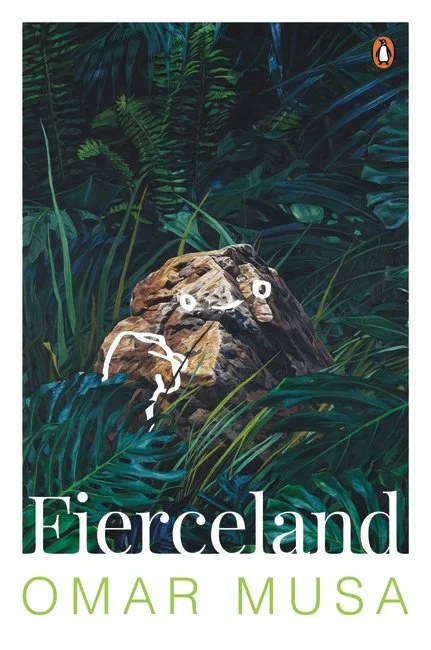
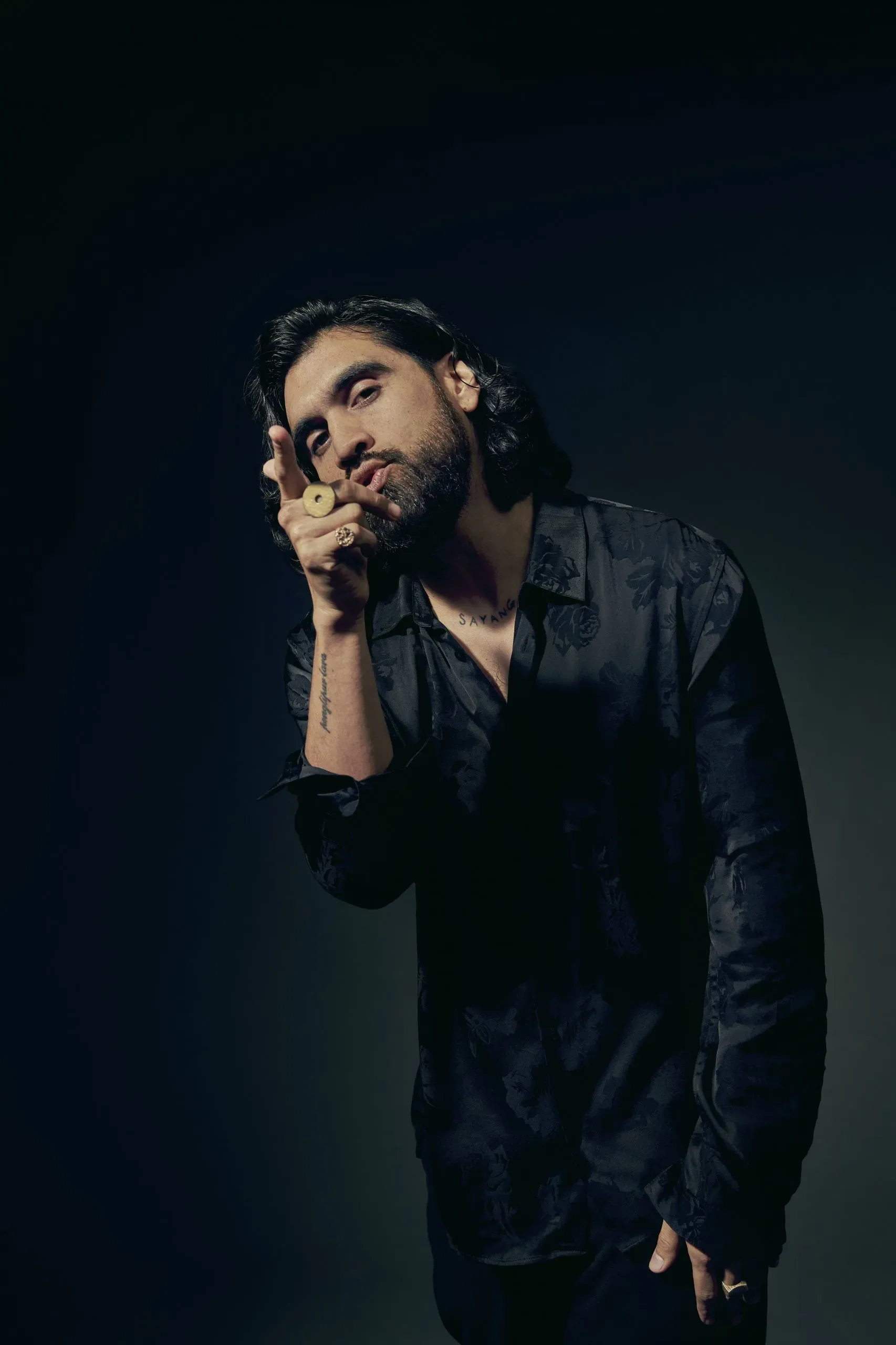
Inheritance and Reckoning in Omar Musa’s Fierceland
I closed Fierceland with the feeling that something essential had been restored to contemporary fiction — a sense of urgency that is both moral and imaginative. Omar Musa’s second novel is a feat of narrative synthesis: a family saga, a postcolonial reckoning, and an ecological lament that refuses to collapse under the weight of its own ambition. It is rare to find a work that carries so many registers — mythic, political, personal — yet remains so readable, so precise in its prose, and so deeply human.
At its heart, Fierceland is the story of return. After their father’s death, Roz and Harun travel from Sydney and Los Angeles back to Malaysian Borneo to confront not only their inheritance but its origins — a fortune built on felled forests, erased histories, and a single act of violence that has haunted their family for decades. Musa’s narrative is driven not by revelation but by reckoning: what does it mean to love someone who has done unforgivable things? What does it mean to live well on stolen land?
The novel’s scope is vast — spanning generations, continents, and mythologies — but Musa’s control of tone and language makes it feel intimate. The prose is musical without affectation, lucid yet layered, its rhythm carrying the reader through dense moral terrain. Sentences move like incantations: “skinned alive, shrieked through the mill, shat out as plank and board.” The rainforest itself speaks, not as a symbol but as a witness — an entity with memory, agency, and pain. Musa’s decision to grant the forest its own voice, to let it speak in first person, is not just stylistic but ethical: it collapses the distance between observer and object, reminding us that exploitation is always a form of deafness.
The novel’s power lies in its refusal to preach. Musa is angry, but his anger is never rhetorical. Instead, it is woven into the grain of the narrative — into the ghosts that haunt the children, the silences between languages, the textures of humidity and decay. The environmental critique is inseparable from the psychological one: the rainforest’s destruction mirrors the corrosion of memory and kinship. Roz and Harun’s father, Yusuf, is rendered with both tenderness and terror — a man who saw modernisation as salvation, who mistook domination for legacy. Musa’s achievement is to hold him accountable without stripping him of complexity.
There are moments in Fierceland that feel almost cinematic in scope — vast aerial sweeps of jungle and river — and others that draw close enough to feel whispered. The fragments of Malay and Manglish throughout the text add texture rather than opacity; Musa trusts his readers to follow, to sit with dissonance and not demand translation. It is this trust that makes the book feel so alive — its multilingualism not a flourish but a statement of fact, an assertion that no single language can carry the weight of hybrid identity.
I found myself unable to look away from the novel’s formal confidence. Musa draws on his background as a poet and rapper, and you can hear it in the rhythm of his sentences, the syncopation of voices, the way dialogue bleeds into myth. The forest is not backdrop but chorus. It is both the setting and the conscience of the book. Through it, Musa achieves something close to alchemy: a synthesis of oral tradition and contemporary realism, myth and reportage.
If there are moments of unevenness — occasional narrative digressions or abrupt tonal shifts — they feel less like flaws than traces of a restless artistic temperament. The novel refuses the smoothness of conventional storytelling because its subject is rupture itself: the breaking of land, lineage, and language.
Fierceland reads as both an elegy and a renewal. It mourns what has been lost — the forests, the languages, the moral coherence of a pre-industrial world — but it also insists on the possibility of reimagining what remains. In doing so, Musa joins a small but vital group of writers redefining the ecological novel: those who treat the environment not as scenery but as interlocutor, not as metaphor but as kin.
I could not get enough of this book. It is exciting, essential, urgent, and yet remarkably clear-headed. Musa writes with the rare confidence of someone who knows that complexity does not require convolution. Fierceland is a novel about inheritance — personal, political, and planetary — but it is also about the act of returning home, of listening again to the voices we have silenced. It is, quite simply, one of the most intelligent and compelling works of fiction I have read in years.
Risk, restraint, and the rise of a cultural city
The final weekend of the Brisbane Festival offered a compact study in the city’s evolving cultural identity — a negotiation between spectacle and sincerity, provocation and polish. Across three nights and a matinee, the programming oscillated between populist pleasure and earnest experimentation, revealing both the confidence and the growing pains of a maturing arts ecology.
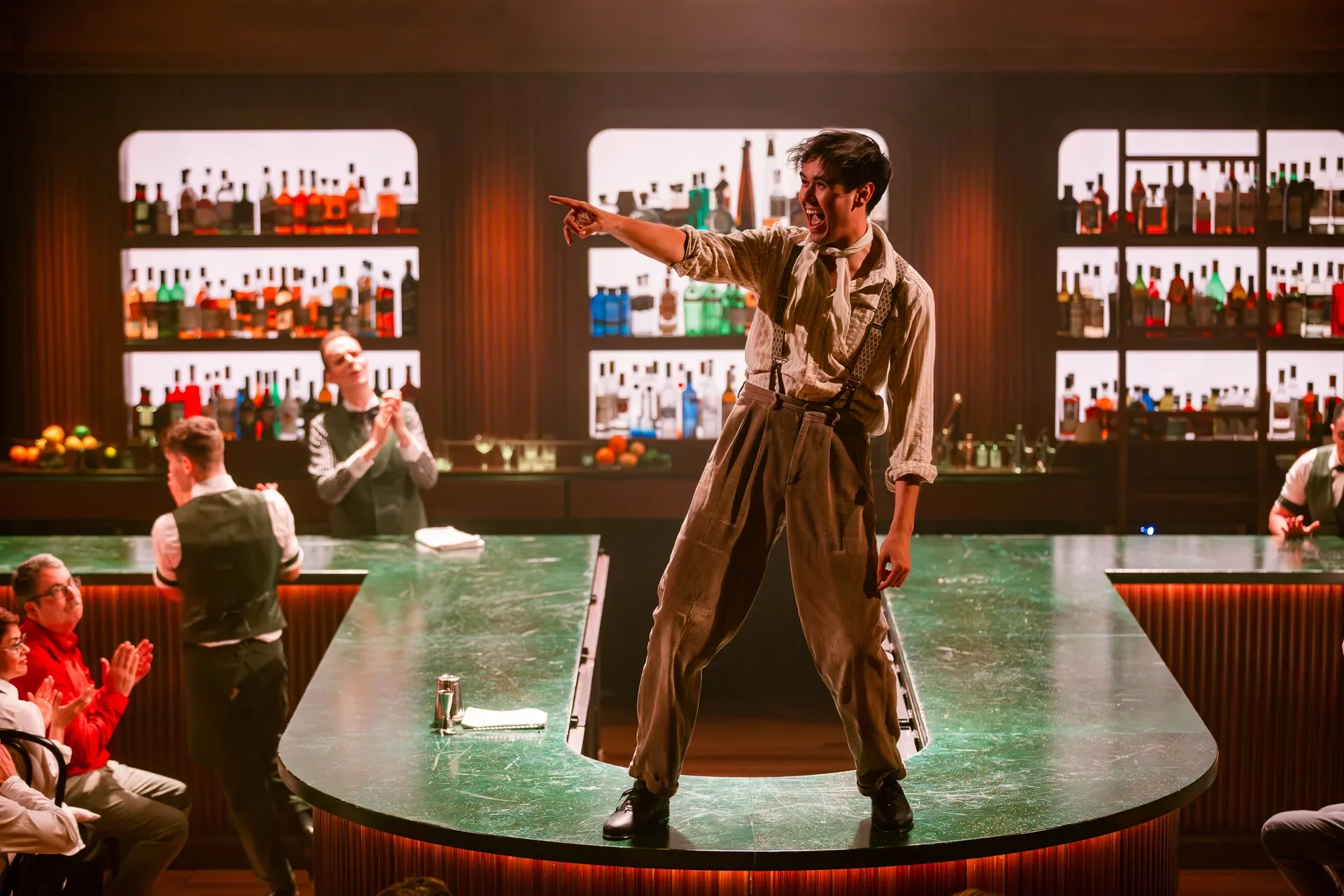
The weekend began on Friday evening with Late Night Vice at The West End Electric, a work that fused the vernacular of nightlife with the structure of theatre. It was both racy and rigorously composed, its performers oscillating between abandon and control with remarkable discipline. The show’s deliberate decadence — cabaret for the knowing middle class — succeeded precisely because it understood its own artifice. Its fault lay only in rhythm: three bar intervals fractured the narrative momentum, replacing immersion with interruption. Nevertheless, it stood as a compelling argument for the vitality of live, site-responsive performance in an age of mediated entertainment.
By early Saturday morning, Something New at Queensland Theatre’s Diane Cilento Theatre offered a sharp contrast. The double bill of Pretty F**ing Autistic and Tracks sought to foreground the lived experience of disabled and neurodivergent artists. Yet despite the importance of its subject matter, the presentation lacked dramaturgical rigour. The readings felt over-determined by their ideological frameworks — anxious to instruct rather than invite. The result was a kind of aesthetic timidity: work that mistook moral clarity for artistic depth. This was not a failure of empathy but of confidence — an unwillingness to trust audiences with complexity. The ethical impulse was genuine, but the theatrical form remained underdeveloped.
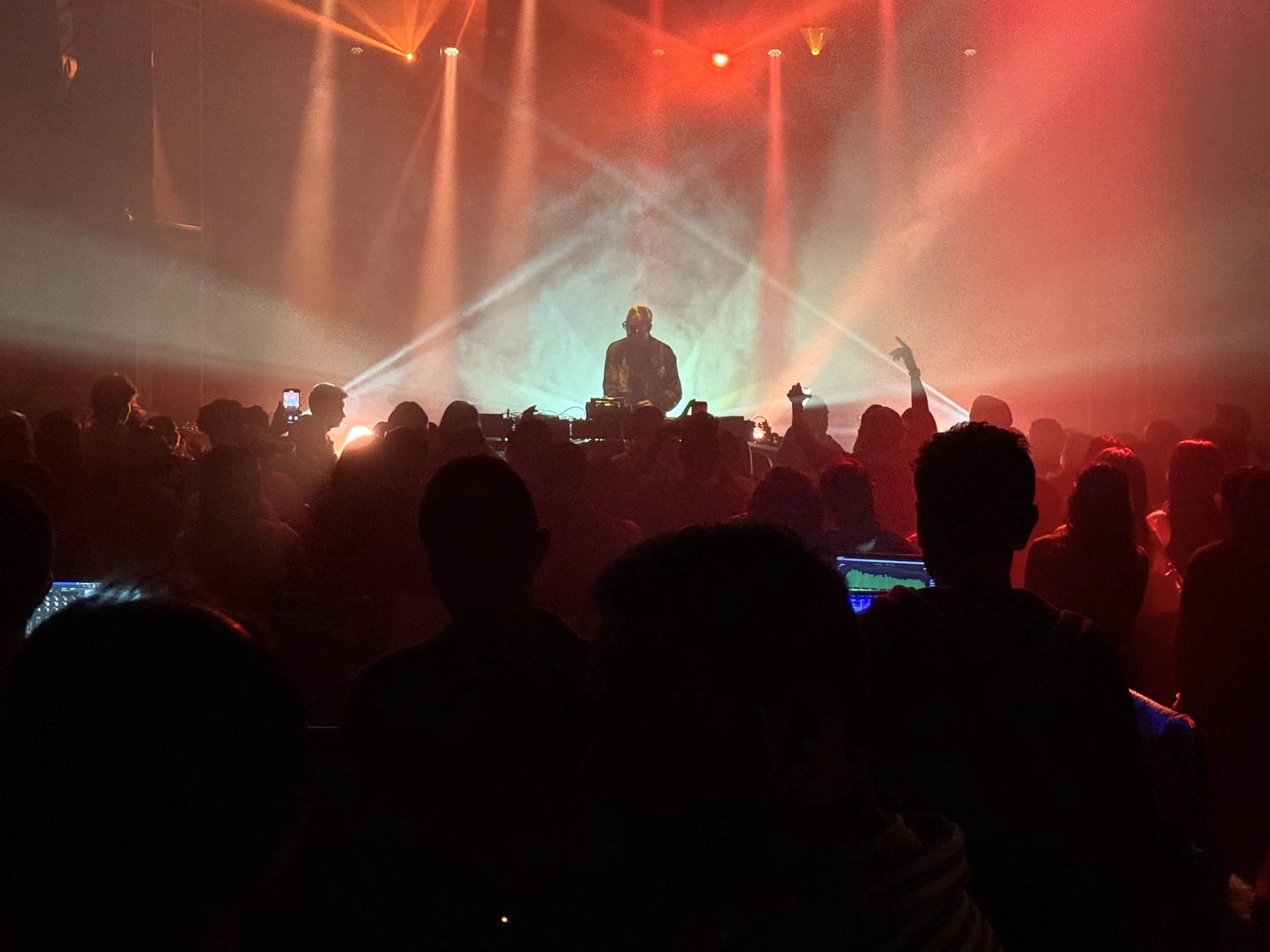
That night’s Indo Warehouse at the Princess Theatre provided a recalibration. The New York-based DJs Kahani and Kunal Merchant offered a demonstration of cultural synthesis that was both disciplined and ecstatic. Their ‘Indo House’ movement reconfigures South Asian rhythmic traditions through the architecture of global electronica, achieving a rare balance between cultural specificity and cosmopolitan accessibility. The Princess Theatre, with its restored nineteenth-century interiors, served as an apt metaphor for Brisbane itself: an old framework pulsing with new sound. The initially reserved audience eventually surrendered to the rhythm, producing a collective, embodied response that felt almost anthropological — a reminder that music, more than rhetoric, remains the most effective vehicle for cultural translation.
Gatsby at The Green Light, staged at the reimagined Twelfth Night Theatre, continued the exploration of performance and identity but through the lens of revivalism. The work’s choreography and production design were impeccable, its aesthetic a meticulous reconstruction of the 1920s filtered through 2020s nostalgia. Yet its self-awareness dulled its subversive edge. In contrast to Late Night Vice, Gatsby aestheticised decadence rather than interrogating it. What remained was a polished simulation of transgression — spectacle emptied of danger.
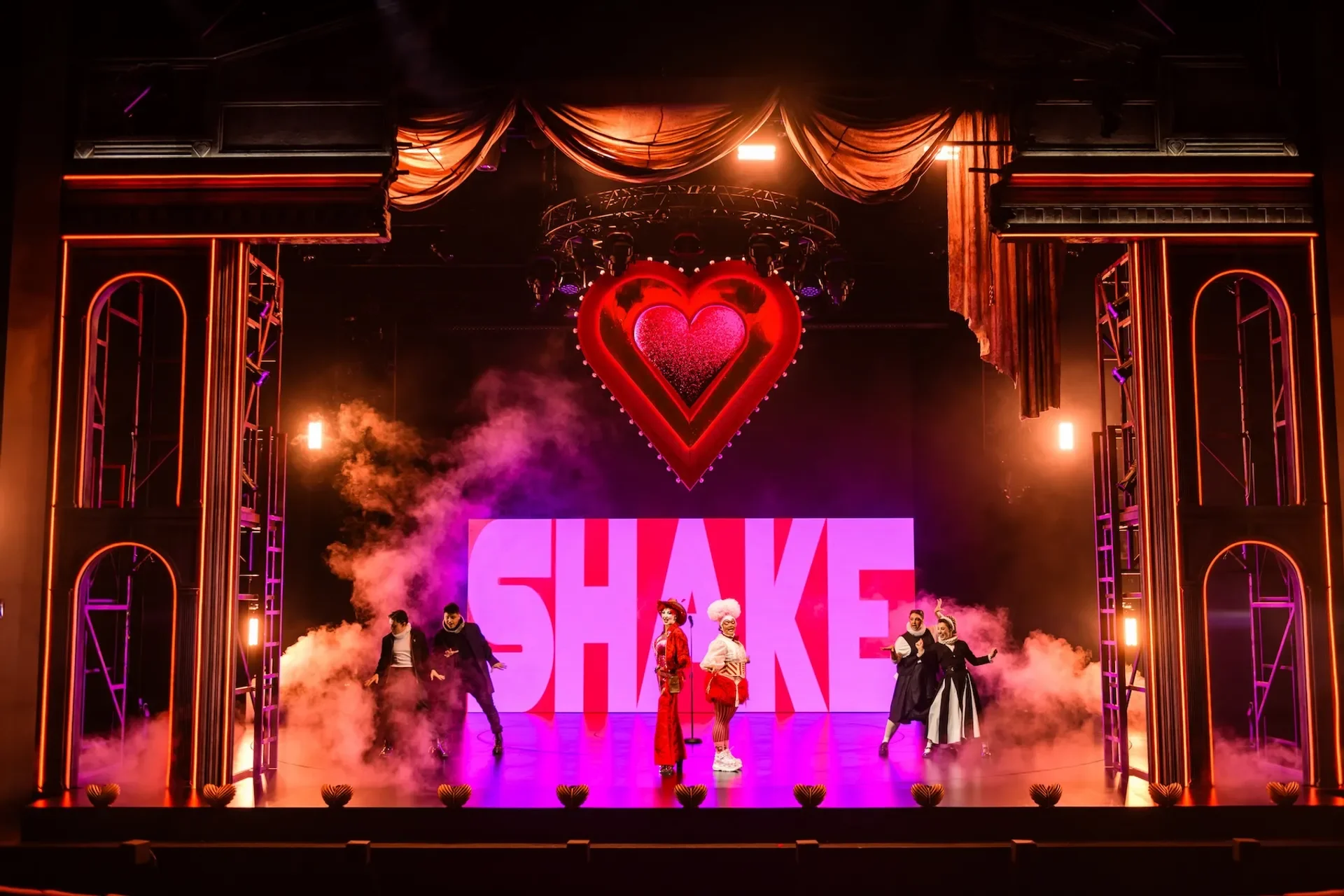
Sunday’s matinee of The Lovers at QPAC provided the weekend’s most integrated experience. Laura Murphy’s adaptation of A Midsummer Night’s Dream, directed by Nick Skubij, successfully balanced accessibility with sophistication. Its pop score was bright and propulsive, its performances precise and emotionally grounded. The production demonstrated an Australian capacity for theatrical craftsmanship that is both locally rooted and globally legible. It neither apologised for its populism nor condescended to it, embodying the kind of cultural confidence the broader festival seemed to be reaching for.
Across these five experiences, a pattern emerged: Brisbane’s artists are no longer seeking validation through imitation but through synthesis — the reworking of established forms into something distinctly regional yet internationally conversant. The festival’s late-style tendency toward hybridity — cabaret as theatre, electronic music as cultural critique, Shakespeare as pop spectacle — speaks to a city asserting itself as a laboratory of aesthetic negotiation.
Not every experiment succeeded, but the unevenness itself is instructive. It reveals a cultural scene in the process of maturing, where ambition occasionally outpaces execution but rarely intention. Brisbane, once defensive about its artistic relevance, now seems willing to risk failure in pursuit of complexity. That, more than polish or perfection, is the true sign of a confident cultural city.

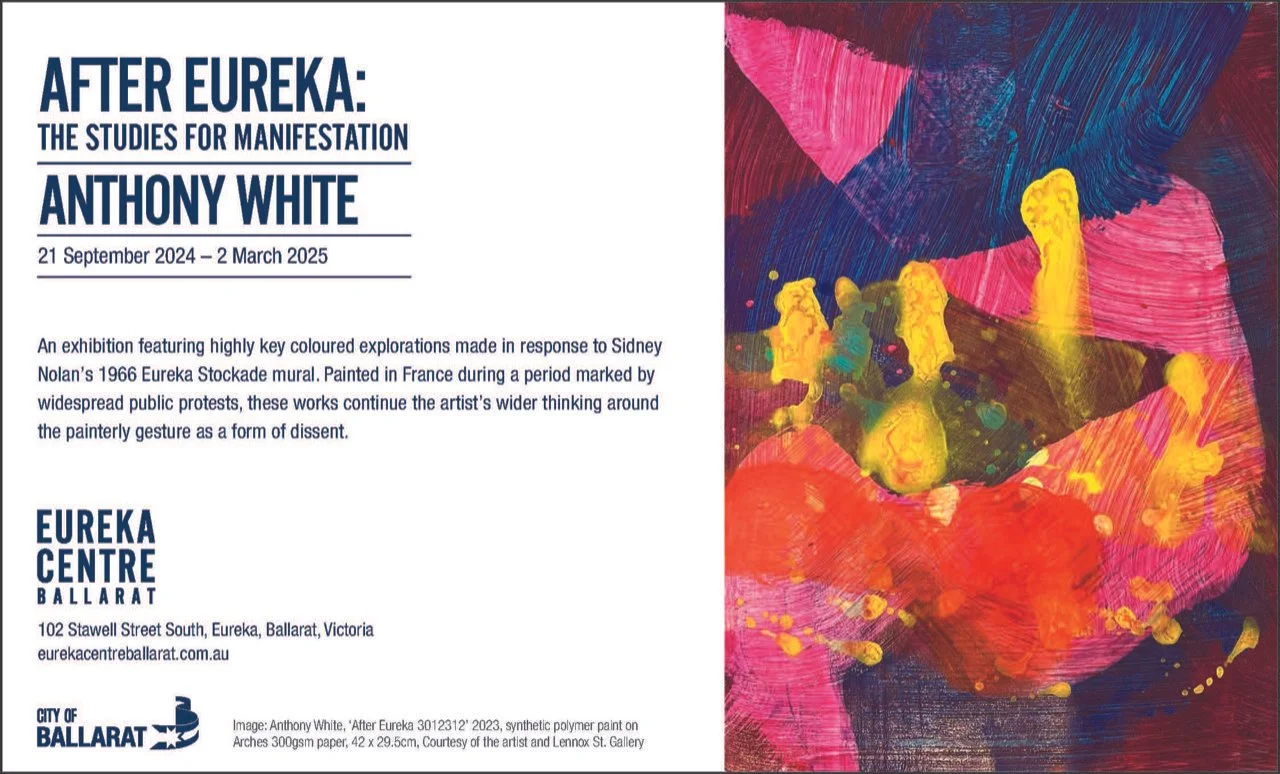
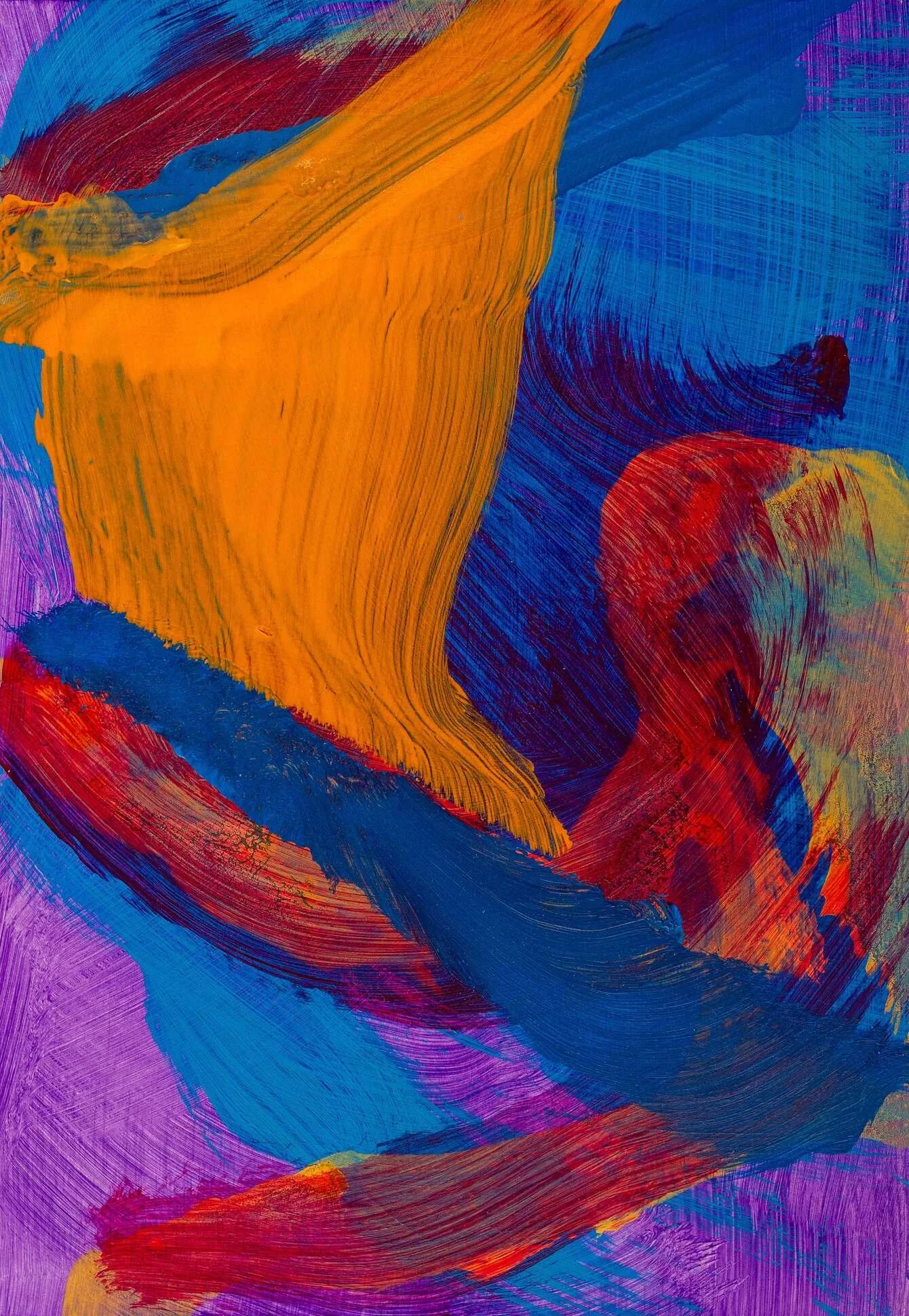
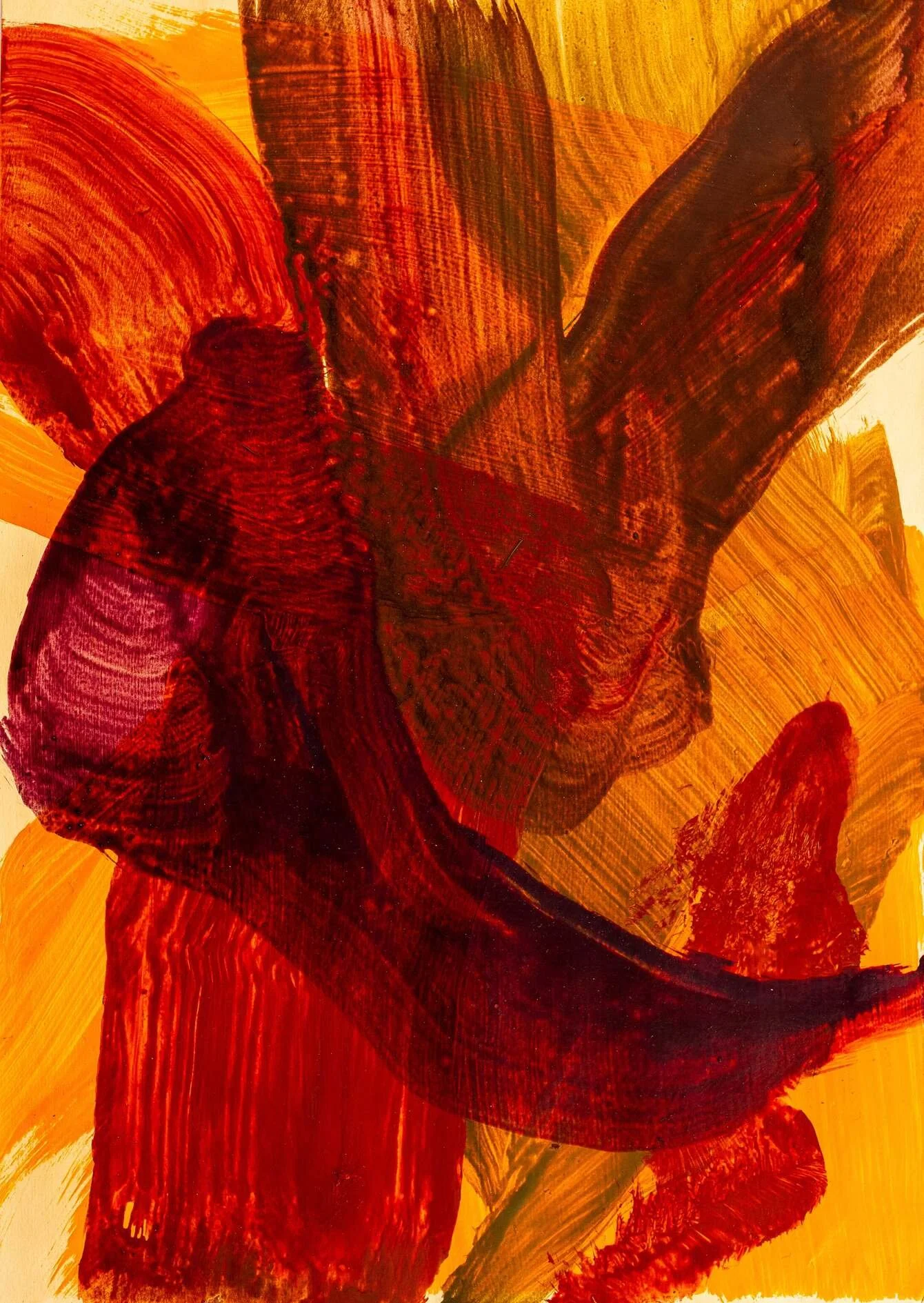
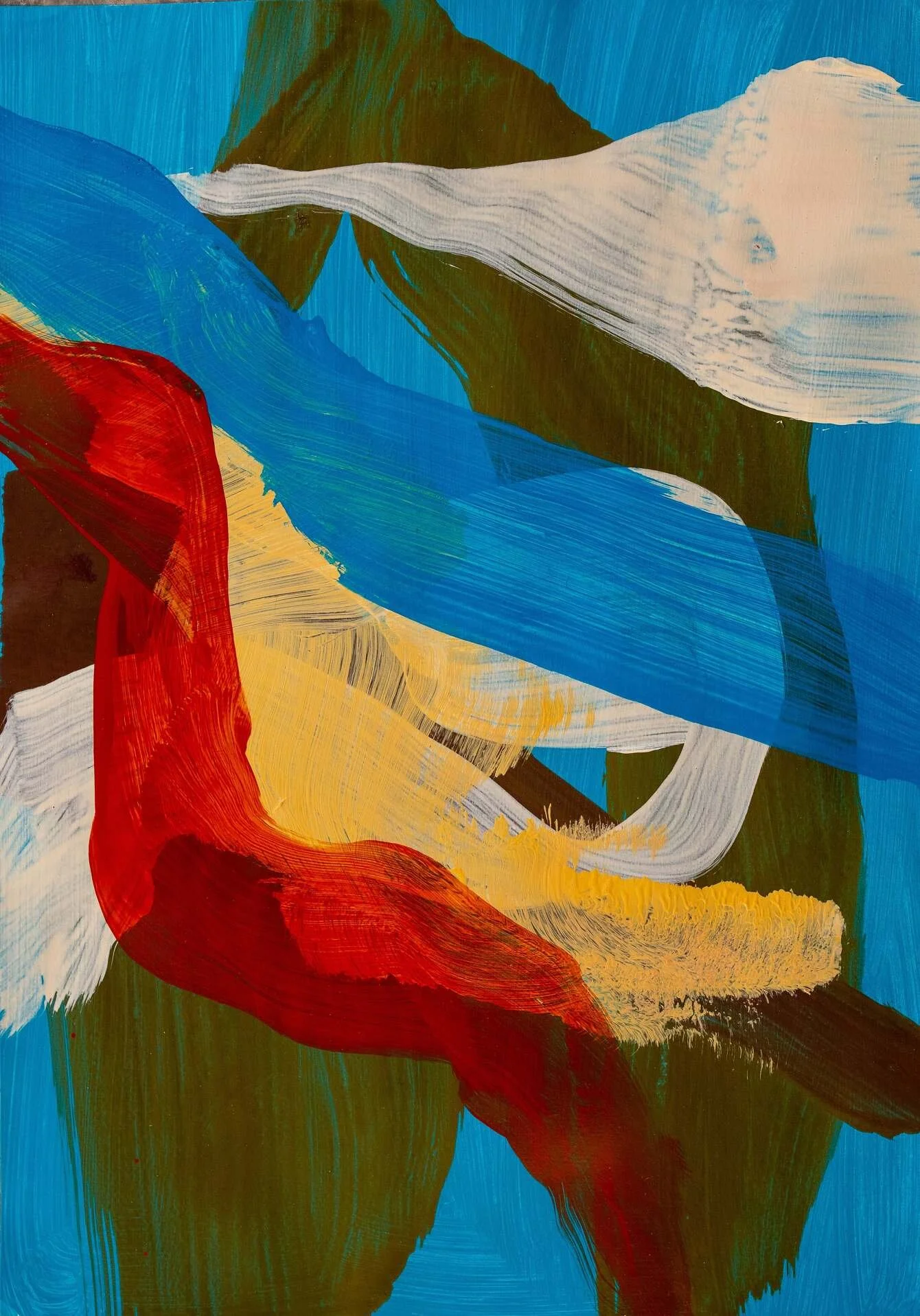
After Eureka
The studies for a manifestation
ANTHONY WHITE
21 September 2024 - 2 March 2025
Eureka Centre
102 Stawell Street South
Wadawurrung and Dja Dja Wurrung Country
Ballarat
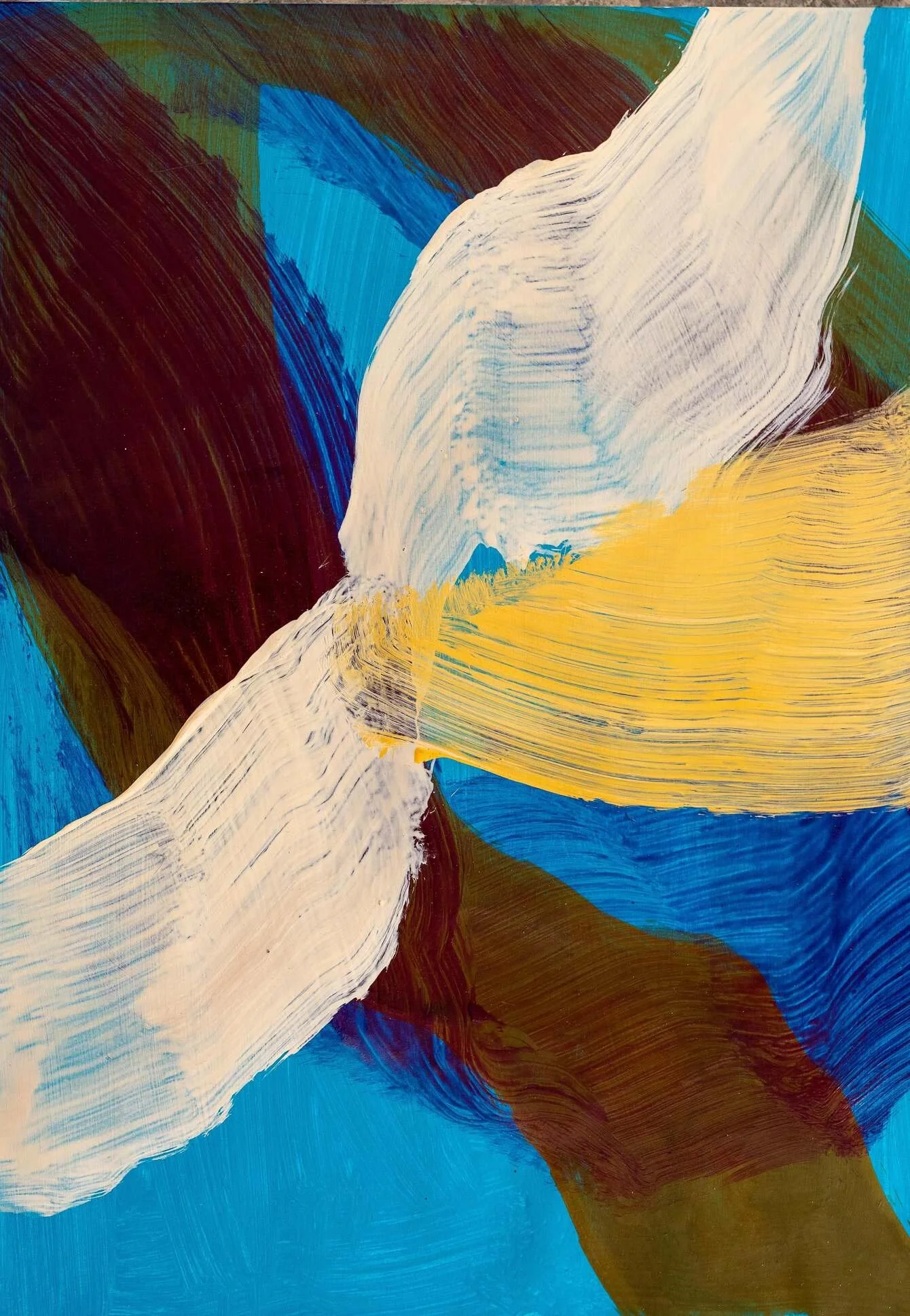
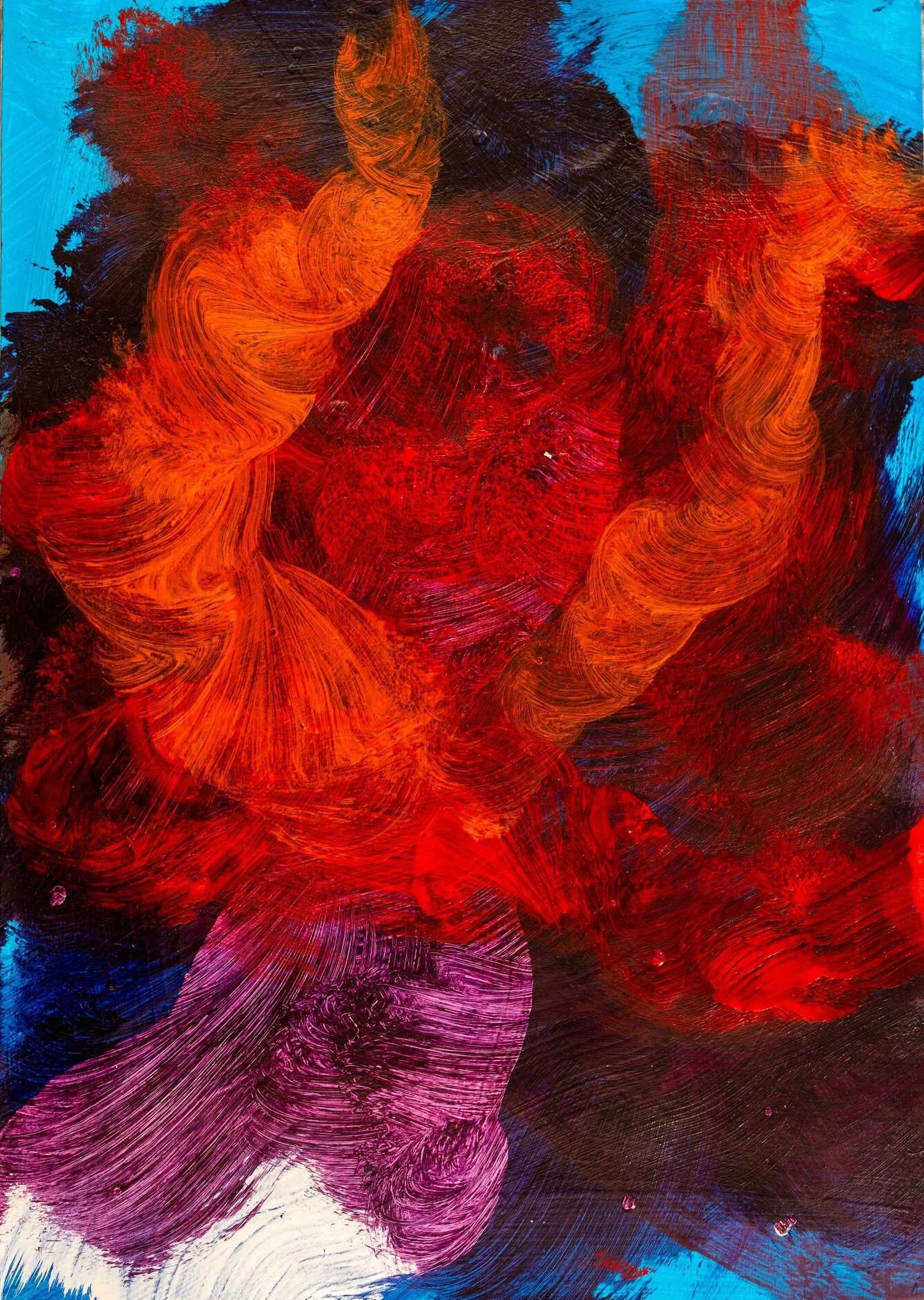
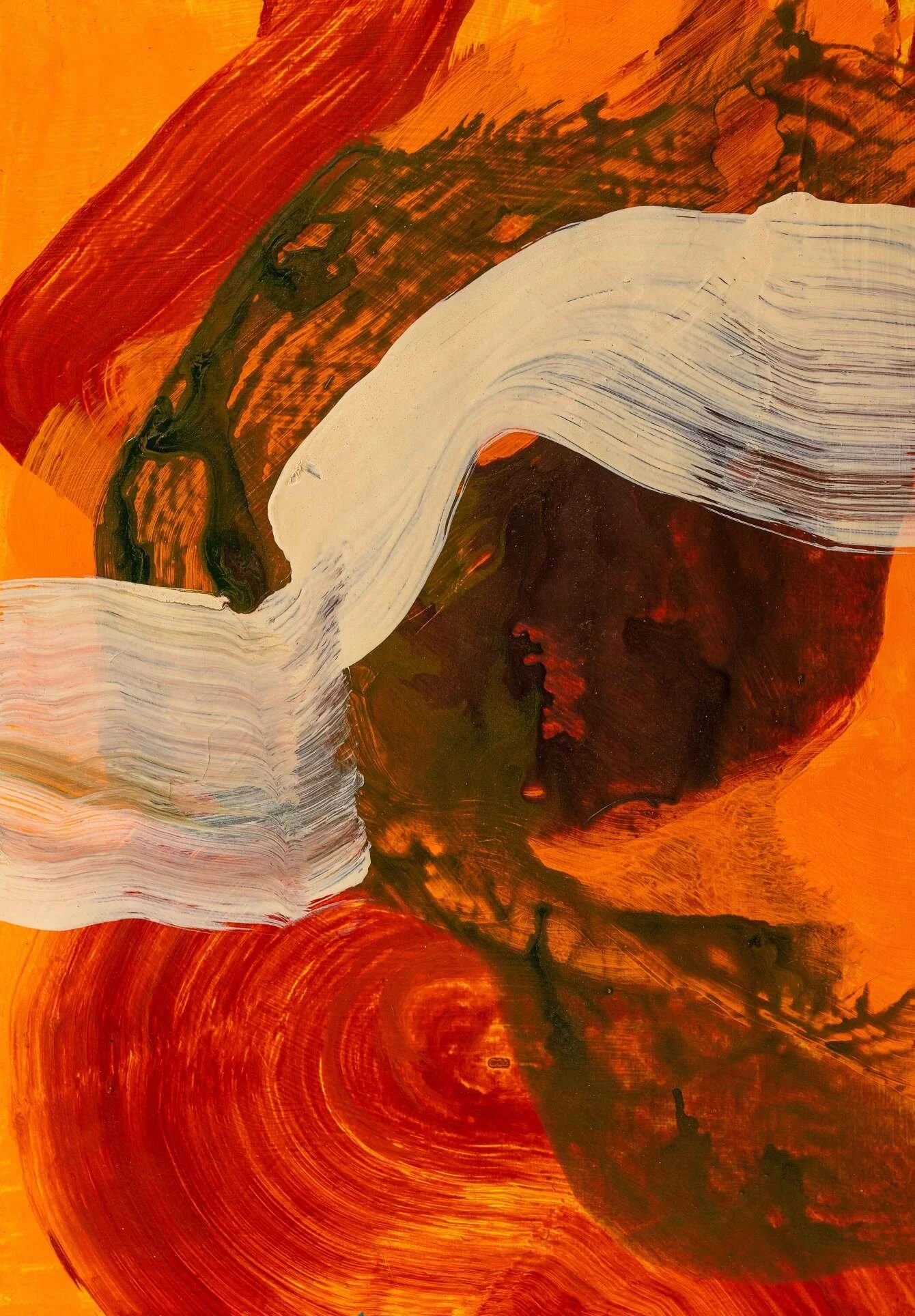
From Saturday, 21 September 2024, to Sunday, 2 March 2025, the Eureka Centre Ballarat will host "After Eureka: The Studies for Manifestation," an exhibition by Paris-based artist Anthony White. The show coincides with the 170th anniversary of the Eureka Stockade, Australia’s only armed civil uprising, and features White's preliminary studies created in response to Sidney Nolan’s 1966 Eureka Stockade mural.
Anthony White’s engagement with material, concept, and history makes this exhibition a compelling exploration of dissent and protest, art and history, at a time when these conversations feel more relevant than ever.
Visit to experience a powerful reflection on one of Australia's pivotal democratic moments through the eyes of a contemporary artist deeply engaged in the ongoing dialogues of protest and resistance.
Anthony White’s work is committed to reclaiming dissent through cultural expression, drawing from a rich intersection of politics, human rights, and postcolonial critique. In his art, concepts of design as social and political expression are woven into painting, drawing, collage, and printmaking. His affinity for modernist aesthetics serves not as a subject but as a language to pose urgent questions about our time, inviting new ways of thinking and emancipation.
White’s prolific career spans exhibitions across Australia, Europe, and Asia. Notable solo exhibitions include *Manifestation* at Lennox St Gallery (2023), the largest presentation of his work in Europe at The Mark Rothko Art Museum, Latvia, and others at Informality Gallery in the UK and Nanda Hobbs Contemporary in Sydney. His work has been recognized in major Australian art prizes such as the Brett Whiteley Travelling Art Scholarship and the John Glover Art Prize, among others, and reviewed by prominent publications like the Australian Financial Review and Art Collector Magazine.
"After Eureka: The Studies for Manifestation" continues White’s exploration of the painterly gesture as a form of dissent and civil disobedience, or, as the French say, *Manifestation*. Created during a period of intense public protest in France, these works on paper delve into the spirit of rebellion, drawing on new research into the Eureka Rebellion and the personal papers of Sidney Nolan. White’s Creative Fellowship research at the National Library of Australia unearthed Nolan's correspondence, offering fresh insights into his response to the events of the 1854 Eureka Stockade, as recounted by Italian revolutionary Rafaello Carboni.
Navigation
11-24 September 2024
Damien Minton Presents
50 Buckingham Street Surry Hills Gadigal/Sydney
The Persistent Horizon of Zuza Zochowski
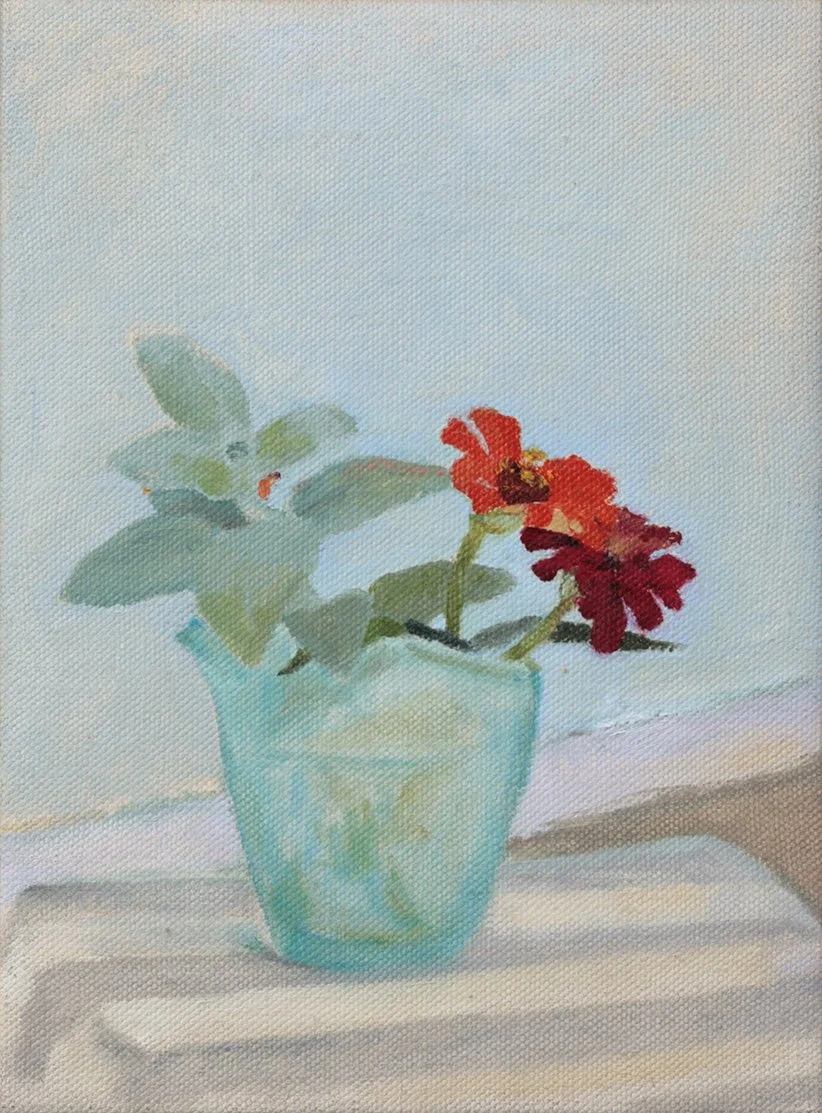
For close to 25 years, I have had the privilege of observing the quiet yet powerful evolution of Zuza Zochowski's practice. Her recent works, presented here in Navigation, continue her exploration of landscapes and still lifes, but with an increasing emphasis on the dialogue between natural environments and human-made structures. These paintings, delicate yet far reaching, reflect a deepened meditation on the Illawarra seascape and the objects that occupy it—whether naturally occurring or humanly constructed.
Zochowski’s land/seascapes, with their subtle hues and restrained compositions, may at first appear deceptively simple. However, a closer examination reveals the profound tension she creates between the organic forms of the land and sea and the rigid, sometimes intrusive, elements of human encroachment. This interplay is reminiscent of the industrial scenes depicted by mid 20the century British artist L.S. Lowry, who constructed "composite townscapes" not from direct observation but from the memories and emotions that these environments evoked. Just as Lowry's urban panoramas are not of any particular place, but rather a blend of various elements, so too do Zochowski’s seascapes amalgamate the real and the imagined.
In these works, the horizon is not merely a division between sea and sky, but a liminal space where the natural world and human enterprise collide. The tankers that dot her canvases are not merely vessels; they are symbols of the relentless march of global commerce, their presence both a testament to human ingenuity and a reminder of its impact on the environment. This duality is central to Zochowski’s recent work: a simultaneous appreciation and critique of the ways in which human structures impose themselves upon the natural world.
This intellectual inquiry is evident in the meticulous yet expressive brushwork that characterizes her landscapes. The coarse marks she refers to in her 2019 conversation with curator and researcher Lizzie Muller, are not merely technical choices but are imbued with meaning, embodying the rugged, sometimes harsh, reality of the industrial seascape. The wires and fence lines that cut across these paintings serve as visual barriers, disrupting the viewer's gaze and compelling us to confront the tension between nature and industry.
These themes extend into her still-life paintings, where the objects she depicts are carefully chosen for their symbolic resonance. The aqua vessel, for instance, which carries flowers from her garden, is more than just a receptacle. Its shape and colour evoke the foreign form of maritime flotsam and jetsam, and a broader cultural, if not peculiarly Australian, associations with the sea. The juxtaposition of organic forms—flowers, fruits—with these man-made objects mirrors the larger dialogue in her landscape paintings, where the natural and the artificial coexist in uneasy harmony.
Chicago based, Canadian photographer, Laura Letinsky’s work, with its delicate interplay of light and form, echoes for me Zochowski’s still lifes, both offering a subtle yet deeply contemplative observation on the essence of objects and the roles they play within our visual experience. Both artists engage with the tradition of the tabletop still life but do so in ways that subvert its conventions. Where Letinsky allows the light of Provence to bleach her images into near-abstraction, Zochowski uses colour and form to create a similarly ethereal effect. Yet, where Letinsky’s work conveys a sense of aftermath—a party long since ended—Zochowski’s still lifes are more concerned with the present moment, with the objects themselves as they exist in time and space, even as they carry the weight of history and memory.
Zochowski’s engagement with the materiality of her subjects—whether the roughness of a painted wire or the texture of a clay-made buoy—adds a tactile dimension to her work that invites the viewer to consider not just what is depicted, but how it is depicted. The clay buoys, for instance, begin as bright, functional objects but gradually become more abstracted, their colours fading like the shells on the beach. This transformation speaks to the passage of time and the inevitable wear that comes with exposure to the elements—a theme that resonates deeply in her seascapes.
The contrast between the bright navigational buoys and the deep blue sea in her paintings also serves as a metaphor for communication, a theme that Zochowski subtly weaves throughout her work. The buoys, with their bright yellows and greens, set courses for ships to follow, just as Zochowski’s compositions guide the viewer’s eye across the canvas. The colours themselves, deep yellows on blue background, reminiscent of nautical flags, signal a desire to communicate, to connect across the vastness of the sea—an impulse that is both deeply human and poignantly isolated, a SOS across the airwaves from the artist, ringing the alarm on an imminently felt climate crisis.
This sense of isolation, of being at the mercy of forces beyond one’s control, is perhaps most keenly felt in her depictions of the horizon. The horizon in Zochowski’s work is not a fixed line, but a shifting boundary, constantly redefined by the elements and by human activity. It is both a destination and a barrier, a place of potential and of limitation. In this way, her work captures the existential tension that lies at the heart of the human experience: the desire to explore, to push beyond the known, and the realization that we are, ultimately, small beings in a vast and indifferent world.
Navigation, as a series, and as an evolution of the artists observational prowess, is a powerful continuation of her lifelong exploration of the intersection between nature and industry, between the organic and the constructed. Through her nuanced use of colour, texture, and composition, she creates works that are at once deeply personal and universally resonant. They are paintings that invite contemplation, that challenge us to consider our own place within the larger forces that shape our world. As we stand before these canvases, we are reminded of the persistent horizon that lies before us—always just out of reach, always beckoning us to navigate the uncertain waters ahead.
Iain Dawson
August 2024



I wish I could be there at Gulkula today, in the heart of North East Arnhem Land, for the unforgettable performances by Witiyana Marika and Dhapanbal Yunupingu. The Garma Festival, Australia's largest Indigenous gathering, is truly a powerful celebration of Yolngu life and culture. This four-day event, hosted by the Yothu Yindi Foundation, is a vibrant showcase of traditional miny’tji (art), manikay (song), bunggul (dance), and storytelling. It's an essential meeting point for the clans and families of the region.
Garma's cultural mission resonates deeply with me. It provides a contemporary space for the expression and presentation of traditional Yolngu knowledge systems and customs, offering an authentic and immersive experience. I always keep a close eye on what's happening here, as it’s more than just a festival—it's a profound expression of cultural heritage and unity.
The National Gallery of Australia has made a historic acquisition, becoming the country's first public collection to own a major painting by the iconic artist Paul Gauguin. The gallery recently purchased "The Blue Roof or Farm at Le Pouldu" (1890) for a whopping US$6.5 million from an international private collector. This remarkable piece previously fetched US$5.3 million at a Christie’s auction in 2000.
To delve deeper into the significance of this acquisition, the NGA hosted an insightful symposium titled "Gauguin’s World: Tōna Iho, Tōna Ao." This afternoon of talks and conversations featured key contributors to the gallery’s catalogue publication, offering a rich tapestry of perspectives. Led by the exhibition’s curator, Henri Loyrette, the discussions brought together leading experts in nineteenth-century painting, Polynesian culture, Tahitian language, and French literature. It was an enriching experience that highlighted the profound impact of Gauguin’s work and its intersections with diverse cultural narratives.
Too long to post here - visit the NGA's YouTube page to view the entire symposium.
Those in Paris over the next fortnight for the Olympics, the Fondation Cartier pour l’art contemporain in Paris is hosting Matthew Barney’s first institutional exhibition in France in over ten years. This exhibition showcases Barney's latest video installation, SECONDARY, alongside new works created specifically for this event. In addition, the Fondation Cartier has organized a series of unique events and performances to complement the exhibition. This is a rare opportunity to experience the groundbreaking work of one of America’s foremost contemporary artists.
Regional visual art festival CEMENTA is coming up in September! Cementa Inc. is an artist-centred and community-driven regional arts organisation based in Kandos in Central New South Wales (NSW), on Wiradjuri Country. Mark your diary and fire up the caravan! CEMENTA 2024 - 19-22 September
I devoured Rachel Cusk's latest novel "Parade" - excited to hear her deep dive into her process.
Rachel Cusk is the author of Outline trilogy, the memoirs A Life’s Work and Aftermath, and several other works of fiction and non-fiction. She is a Guggenheim fellow. She lives in Paris.
I just finished Jessie Tu's second novel, "The Honeyeater". She references this short experimental film in the book, that follows the story of a Taiwanese Australian fiction translator. Harrowing film, at 22 minutes its worth the watch.
If you can't be there in person, there's a YouTube creator who has done the tour for you! Loved seeing what was on offer at Art Basel this year. Art Basel is a meeting place for artists, art collectors and many celebrities from the art scene. The high-calibre exhibitions showcase various art forms, with both works by modern masters and art by emerging talents. Art Basel brings the art world to life – which is why it is so successful.
I've fallen in love with Laura Lentinsky's still life photographs. Makes me want to pick up a camera again. Throughout her career, Laura Letinsky has engaged with the fundamental question of what precisely constitutes a photograph. Investigating photography’s relationship with reality, Letinsky began by photographing people but shifted to focusing almost exclusively on objects in the form of the still life. Her large-scale, carefully crafted scenes often focus on the remnants of a meal or party, as she plays with ideas about perception and the transformative qualities of the photograph.
This Saigon based American chef explores the never ending wealth of food offerings in Saigon. When I visited a year ago I found his choices of street food vendors impeccable! Well worth a follow, especially for his Bahn Mi ratings!
A fascinating insight into the creative process of a powerful printmaker. Kollwitz develops and abandons entire compositions as she revises the work, deepening her focus on the woman and intensifying her emotion and strength. As Kollwitz works, we sense her resistance to tropes (a male figure helping the woman, for example) and her painstaking search for the clearest possible message.
I visited this museum earlier in 2024 and just missed this exhibition. Would have loved to have seen this in the home Tai Kwun is Hong Kong’s beating cultural heart, enabled by The Hong Kong Jockey Club (HKJC) in partnership with the Hong Kong SAR Government. A vibrant, welcoming space that brings people together, Tai Kwun is committed to inspiring the community through arts, culture and heritage. of neon, Hong Kong.
This took my breath away,. I maintain that Haute Couture is the nexus of cutting edge creativity! Seriously worth the watch. Under the Pont d’Alexandre III after dark, down rain-soaked steps, with the Seine roiling alongside, we stepped through an underground door- and into a rancid Parisian nighttime joint with bare floorboards, cafe tables, dim mirrors, and a bar overflowing with spent drinks. And here, sitting at wooden tables in the eerie yellowed light, we witnessed John Galliano conjure a world of characters and couture that was a more staggering, shockingly 100% Galliano experience than fashion has enjoyed for years.
Theater, emotion, rebels, and romantic-historical fantasies have fueled Galliano’s creativity forever. This time—according to house notes—it started with Brassai’s 1920s and ’30s portraits of the night-time underbelly of Paris’s clubs and streets.
It was so fantastic to be back in Hong Kong this year for Art Basel HK! An incredible showcase of contemporary art from across the Asia Pacific region. 23 international galleries known for their engaging program will join the fair for the first time: Station (Melbourne, Sydney), Tim Van Laere Gallery (Antwerp, Rome), Almeida e Dale Galeria de Arte (São Paulo), Mangrove Gallery (Shenzhen), Hua International (Berlin, Beijing), Fitzpatrick Gallery (Paris), Galerie Zink (Seubersdorf in der Oberpfalz), Gallery 1957 (Accra, London), Galleria Massimo Minini (Brescia), Waitingroom (Tokyo), PTT Space (Taipei), Each Modern (Taipei), Public Gallery (London), Alison Jacques (London), YveYang (New York), Bortolami (New York), Nonaka-Hill (Los Angeles), Rodeo (London, Piraeus), Dvir Gallery(Brussels, Paris, Tel Aviv), Chini Gallery (Taipei), √K Contemporary (Tokyo), Linseed(Shanghai), and Chapter NY (New York).
After a gestation of over a decade and the extended pandemic shutdown, it was fabulous to finally visit the incredible contemporary art museum M+ in Kowloon Hong Kong. The most impressive contemporary art museum outside of Museum MACAN, Indonesia and the new addition to the Art Gallery of NSW. M+ is an art museum located in the West Kowloon Cultural District of Hong Kong. It exhibits twentieth and twenty-first century art encompassing visual art, design and architecture, and moving image.